
Ingredients
Overnight poolish
- 150 g all-purpose flour
- 150 g water room temperature
- 0.2 g instant yeast about a scant 1/16 teaspoon
Final dough
- 350 g all-purpose flour plus a little for dusting as needed
- 200 g water room temperature
- 3 g instant yeast about 1 teaspoon
- 10 g fine salt about 1 2/3 teaspoons; weighing is more reliable
Optional oven steam
- 120 ml boiling water not part of the dough; use only with an oven-approved steam method
Equipment
- 1 Kitchen scale A precision scale is helpful for the tiny starter yeast amount.
- 1 Large mixing bowl and cover
- 1 18 × 13-inch rimmed baking sheet and oven-safe parchment
- 1 Bench scraper
- 1 Bread lame or very sharp knife
- 1 cooling rack
- 1 Heavy uncoated metal or cast-iron steam pan Optional; only if your oven permits this steam method. Never use glass or ceramic.
- 1 Long-spouted heatproof pouring vessel and dry oven mitts For optional steam water.
Instructions
Make the starter
- The evening before baking, stir the 150 g flour, 150 g water and 0.2 g yeast together until no dry flour remains. Cover with room for expansion. Leave 10–14 hours around 68–72°F (20–22°C), until bubbly and aerated, with the domed top just beginning to flatten. Temperature changes the timing.
Mix and ferment
- Stir the poolish with the remaining 200 g water. Add 350 g flour, 3 g yeast and 10 g salt. Mix until all flour is moistened. Cover and rest 20 minutes, then knead gently for 3–5 minutes until more cohesive. The dough should remain soft and tacky; do not add flour just to make it dry.
- Cover and let rise about 2 hours. After 30 minutes and again after 60 minutes, use damp hands to lift and fold each of four sides toward the center. Keep covered between folds. At the end, look for a puffier, aerated dough about 50–75% larger; allow more time in a cool kitchen.
Shape and proof
- Turn onto a lightly floured counter. Divide into 3 equal pieces, about 288 g each before dusting flour. Gently form short logs, cover and rest 20 minutes.
- Gently pat one piece into a rectangle without pressing out all the gas. Fold the upper third toward the middle and seal; fold the lower third toward the middle and seal. Fold lengthwise in half and pinch the seam closed. Roll gently from the center outward to a roughly 14-inch loaf. If the dough springs back, cover and rest 5–10 minutes before continuing. Repeat.
- Set seam-side down on an 18 × 13-inch parchment-lined baking sheet, leaving about 2 inches between loaves. Cover loosely and proof 45–60 minutes, until puffy and a gentle fingertip indentation returns slowly. During proofing, preheat a conventional oven to 450°F (230°C), with the bread rack in the center. For optional steam, put a heavy uncoated metal or cast-iron pan on a lower rack only if your oven manual permits it. Do not put it on the oven floor or use glass or ceramic.
Bake and cool
- Uncover. With a sharp lame angled about 30–45 degrees to the surface, make four shallow, slightly overlapping diagonal cuts along each loaf, about 1/4 inch deep. Put the bread tray on the center rack. If using steam, wear dry mitts and carefully pour 120 ml boiling water into the lower hot metal pan using a long-spouted heatproof vessel. Stand back, keep your face clear, avoid splashing the oven glass or light, and close the door. Omit steam if the oven manufacturer prohibits it.
- Bake 25–30 minutes, until richly golden brown. After about 15 minutes, briefly open the door while standing back to release steam, then close it and finish baking. Leave the steam pan in place until completely cool; do not carry it out hot. Move the loaves to a wire rack and cool at least 30 minutes before slicing.
Nutrition
Serving: 0.25 baguette (1/12 batch)Calories: 153kcalCarbohydrates: 31.9gProtein: 4.4gFat: 0.4gSaturated Fat: 0.1gPolyunsaturated Fat: 0.2gSodium: 324mgPotassium: 47mgFiber: 1.2gSugar: 0.1gCalcium: 7mgIron: 1.9mg
Video
Notes
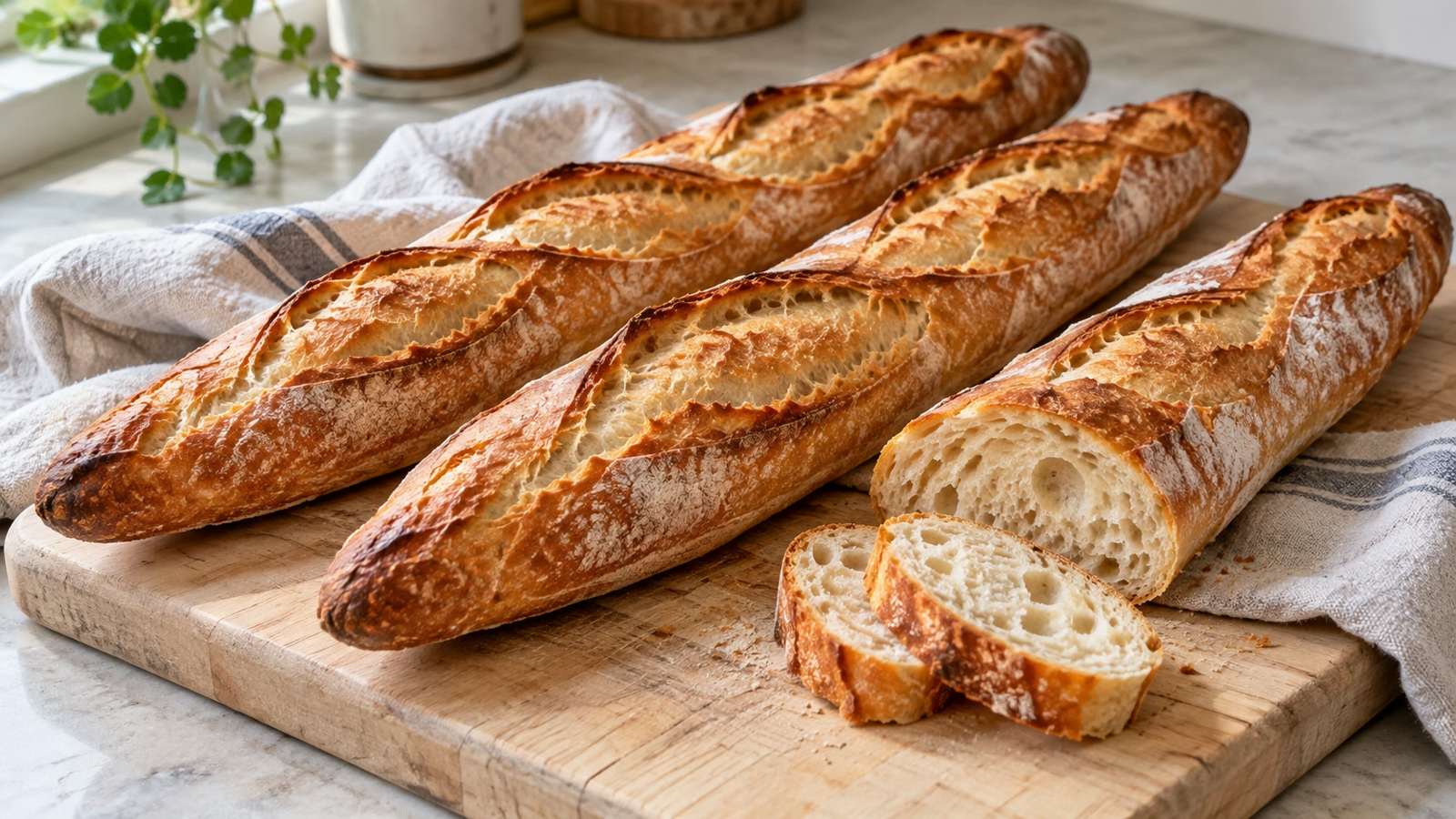
Yield: 3 short baguettes; nutrition is for 1/4 of one loaf (1/12 batch), not an assumed baked gram weight. Total time uses a 12-hour poolish, 2-hour bulk rise, 20-minute bench rest, 45-minute proof and 30-minute cooling period; fermentation varies with room temperature. The initial mixing rest is included in prep time.
Storage: Enjoy cooled bread within a day in a paper bag at room temperature. Freeze well-wrapped cooled portions for up to 1 month for best quality. Thaw and warm briefly in the oven. Discard moldy bread.
Video: King Arthur Baking Company's “5 Tips: Shaping Baguettes” demonstrates shaping technique. Follow this card's original ingredient quantities and schedule; the video is a technique reference, not a demonstration of this exact formulation.
Nutrition estimate: Calculated from USDA FoodData Central SR Legacy entries for 500 g enriched all-purpose flour (168936), 3.2 g dry yeast (175043, an active-dry proxy for instant) and 10 g table salt (173468), divided into 12 servings. Water contributes no calories. Extra dusting flour is excluded. Flour fortification, brands and portion sizes change the result. These are calculated estimates, not laboratory measurements; cooking-sensitive vitamins, trans fat and cost are not reliably established.
