
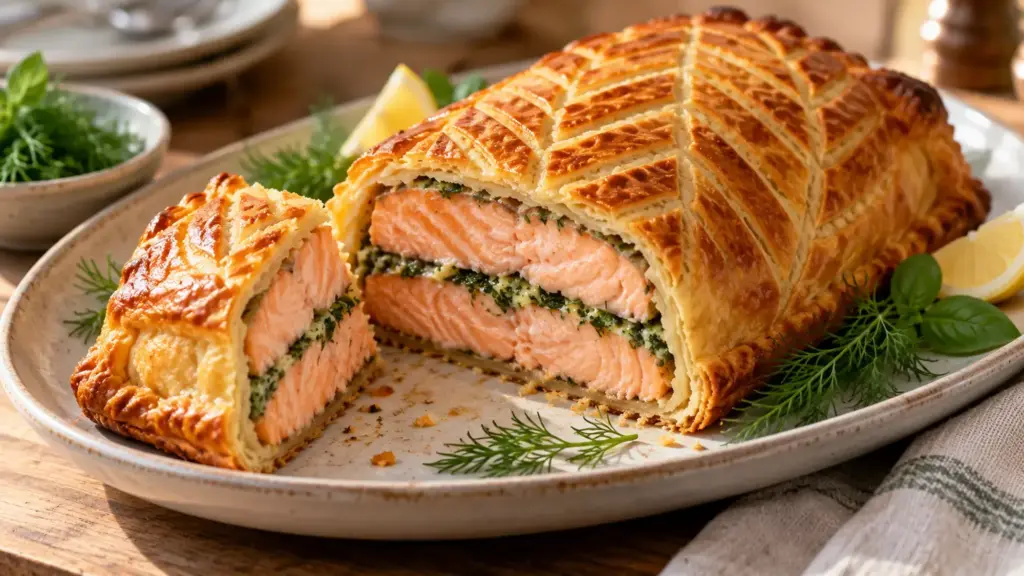
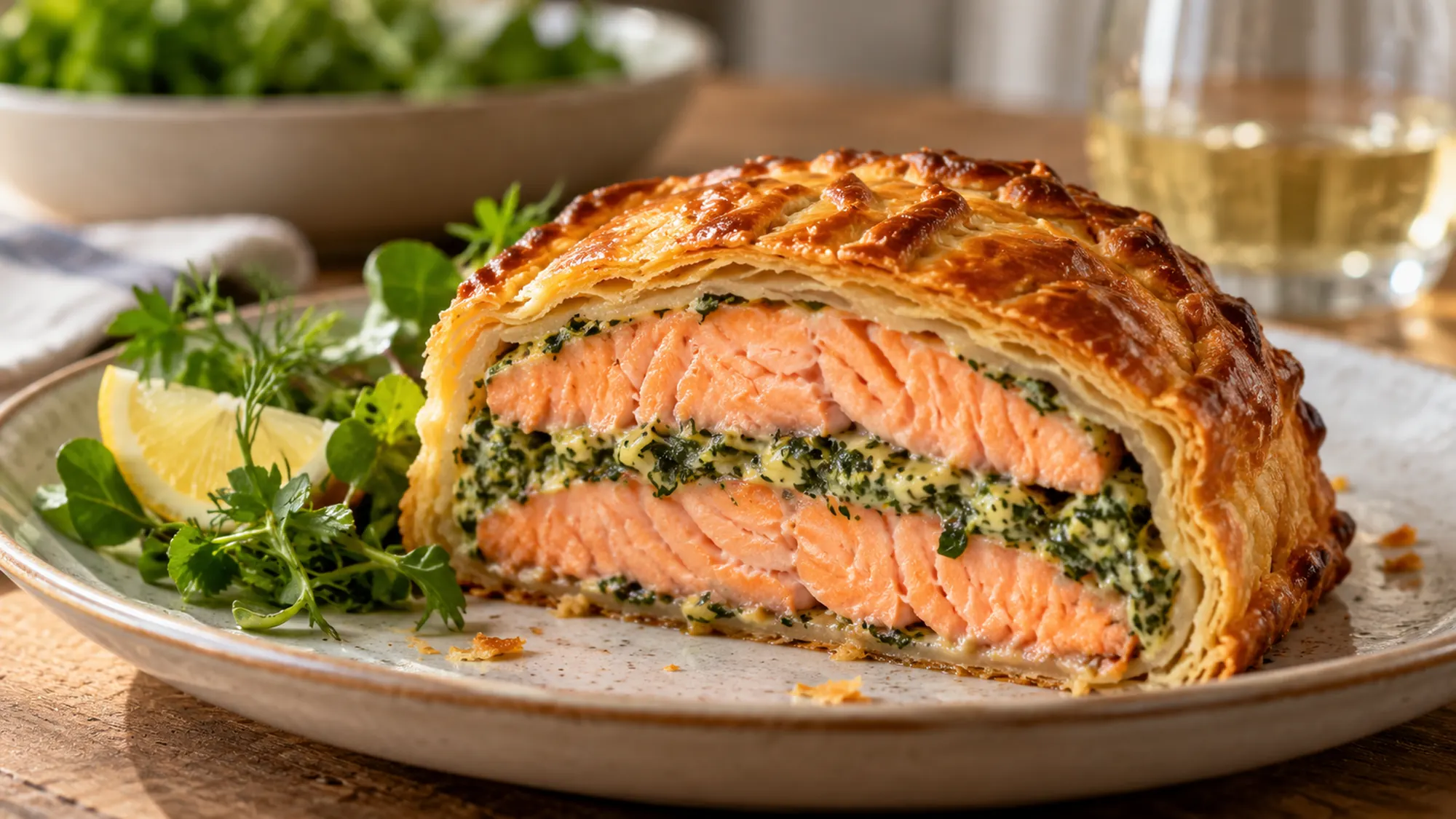
Cutting into salmon en croute should reveal more than an impressive wrapper. The pastry needs a tender bite, the fish should remain distinct, and the herb butter should sit between the salmon rather than turning the plate into a puddle. A little care before baking makes that easier.
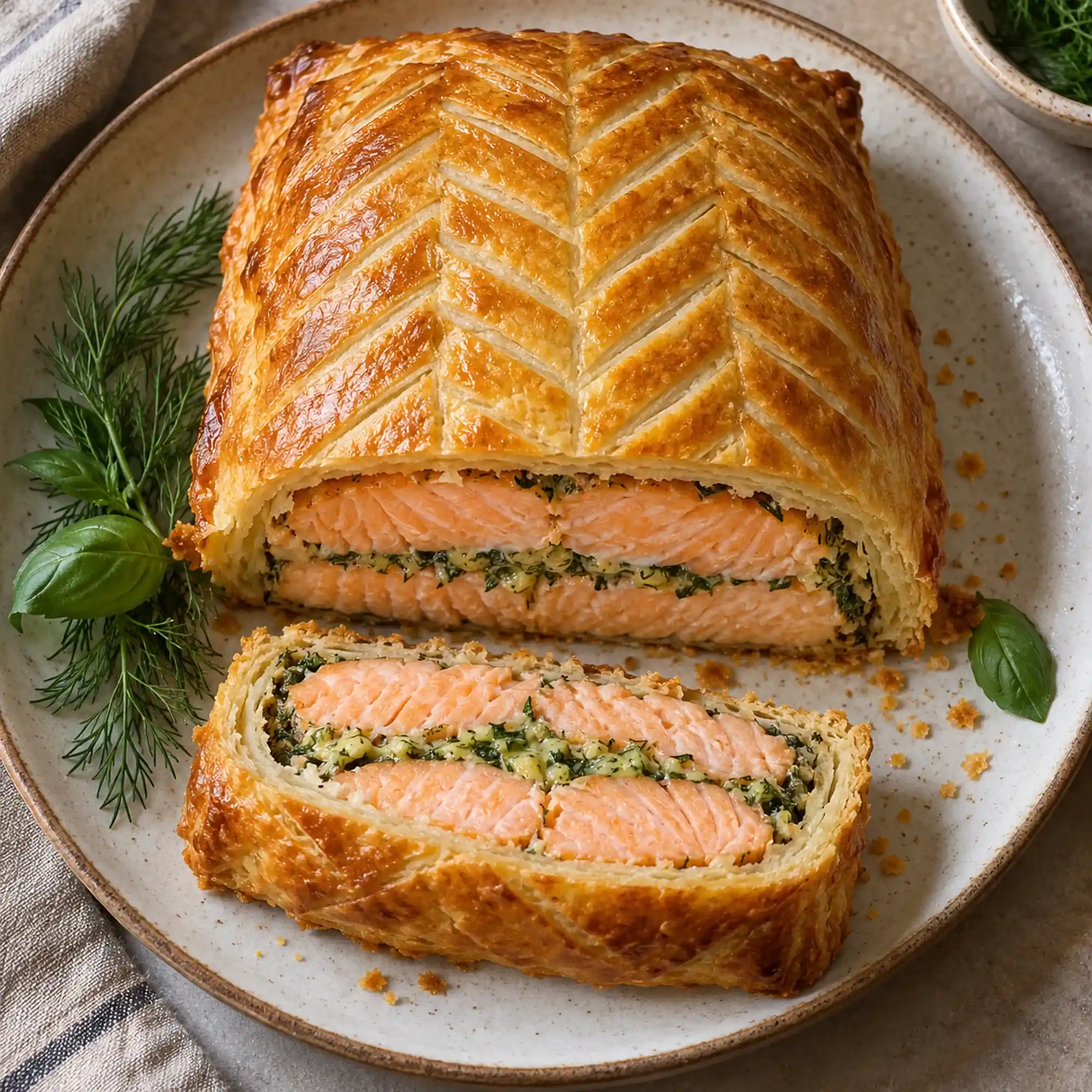
This salmon en croute encloses two pieces of salmon and lemon-herb butter in homemade shortcrust pastry. Chill the dough, seal the parcel neatly and use a thermometer rather than judging the fish by the crust’s color alone.
The filling follows Gordon Ramsay’s ITV version, with a simple measured pastry. I prefer this restrained herb filling to a crowded interior; the slice looks clear and the salmon remains the main event.
Serving Salmon en Croute
Let the parcel rest briefly, then use a sharp knife to cut deliberate slices. Pressing down repeatedly with a blunt blade breaks the crust before it reaches the fish. A broad spatula underneath each portion helps carry the base to the plate instead of leaving it behind.
The pastry already provides a substantial starch and plenty of butter. A green vegetable or crisp salad is usually enough beside it. The source’s rice and separate sauce are optional alternatives, not part of this recipe’s stated cost or nutrition.
- For a green side: green beans keep the plate simple.
- For a cool contrast: choose a lightly dressed cucumber salad.
- For serving: use warm plates, but do not cover the pastry tightly and trap steam.
| Detail | Why it matters | Practical choice |
|---|---|---|
| Sharp knife | Cuts the crust cleanly | Use steady slices |
| Simple vegetable | Balances the rich parcel | Avoid another creamy sauce |
| Brief rest | Makes portions easier to lift | Keep the top uncovered |
Serve clean slices with a simple side; the fish, pastry and herb butter do not need another rich layer.
Salmon en Croute Variations
Shortcrust and puff pastry are not interchangeable descriptions. This dough is rubbed to fine crumbs before water is added, producing a tender, crumbly shell rather than tall laminated layers. If you choose puff pastry instead, follow its handling guidance and expect a different result.
I would keep the filling cool and the salmon surface dry before wrapping. Excess liquid makes sealing harder and works against the pastry base. The small amount of mustard belongs inside the herb butter, where it supports the lemon without becoming a thick separate coating.
- Different herbs: change the dill-basil balance, but avoid adding a large wet filling.
- Prepared shortcrust: use an unsweetened pastry and check its weight, ingredients and baking directions.
- Smaller parcels: individual portions change both wrapping and cooking time; check each one.
- No mustard: omit it if needed, recognizing the filling will taste less tangy.
- A warm kitchen: return soft dough to the refrigerator instead of adding repeated handfuls of flour.
Keep the pastry cool, the fish dry and the filling compact; those choices matter more than elaborate decoration.
Nutrition and Safe Cooking
Salmon contributes protein, but this is also a butter-rich pastry dish. The recipe includes butter in both the dough and filling, so a small slice can be substantial. Serving it with vegetables offers contrast without pretending the pastry becomes a low-fat food.
The estimate includes all pastry, the measured dusting flour and one egg yolk, even if a little remains on the board or brush. It excludes optional rice and sauce. Actual portions depend on how evenly the fish is shaped and how the parcel is cut.
- Check the fish: the minimum fish temperature is145°F; insert the probe into the center.
- Handle separately: keep raw fish away from ready-to-eat salad and utensils.
- Protect the crust: if it browns before the fish is ready, cover loosely rather than removing an undercooked parcel.
Treat the golden crust as a texture cue, not proof that the center has reached a safe temperature.
Bottom Line
Salmon en croute feels special because the components arrive together in one neat slice. A cool, simple dough and a modest herb filling make the preparation manageable. Give the fish an accurate temperature check, let the parcel settle briefly and keep the rest of the plate uncomplicated.
A well-sealed parcel and a careful temperature check are more useful than a complicated pastry pattern.
Salmon En Croute Recipe

Ingredients
- 300 g all-purpose flour for pastry
- 150 g cold unsalted butter cubed, for pastry
- 50 ml ice-cold water approximately, add only as needed
- 4 g fine salt 2 g pastry, 2 g filling
- 900 g skinless boneless salmon fillet cut into two equal pieces
- 80 g softened unsalted butter for filling
- 5 g wholegrain mustard
- 10 g fresh dill chopped
- 10 g fresh basil chopped
- 3 g lemon zest
- 15 ml lemon juice
- 1 g ground black pepper
- 1 egg yolk about 18 g, beaten with 1 tsp water
- 10 g all-purpose flour for rolling
Equipment
- 1 Mixing bowl
- 1 Rolling Pin
- 1 Baking sheet
- 1 pastry brush
- 1 Instant-read thermometer
Instructions
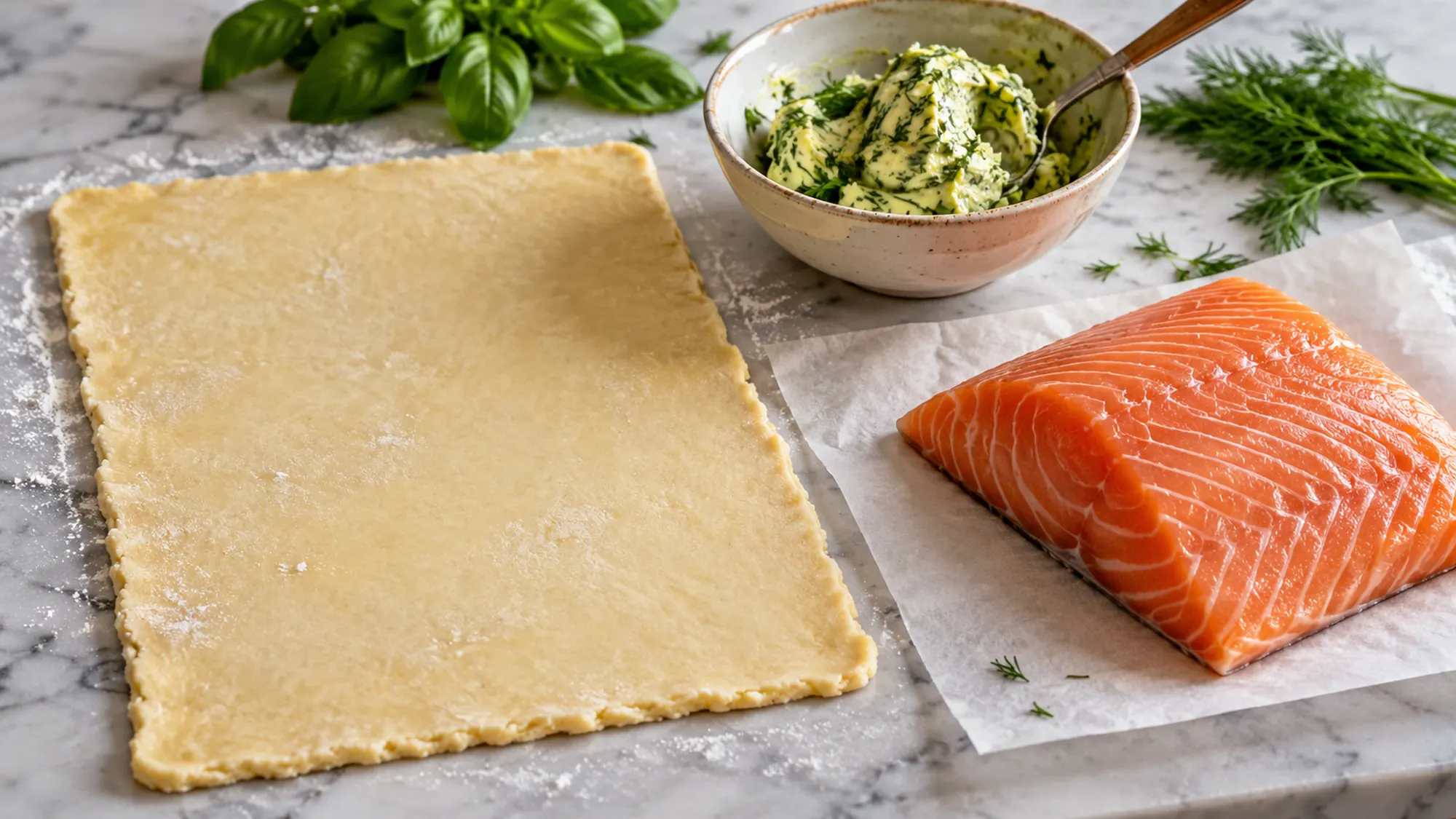
- For the pastry, rub 150 g cold butter into 300 g flour and 2 g salt until fine crumbs form. Add cold water gradually, stopping as soon as the dough holds together. Flatten, wrap and refrigerate 30 minutes.
- Mix 80 g softened butter with mustard, dill, basil, zest and lemon juice. Pat salmon dry and season with remaining salt and pepper. Spread the herb butter between two equal salmon pieces, stacking them neatly.
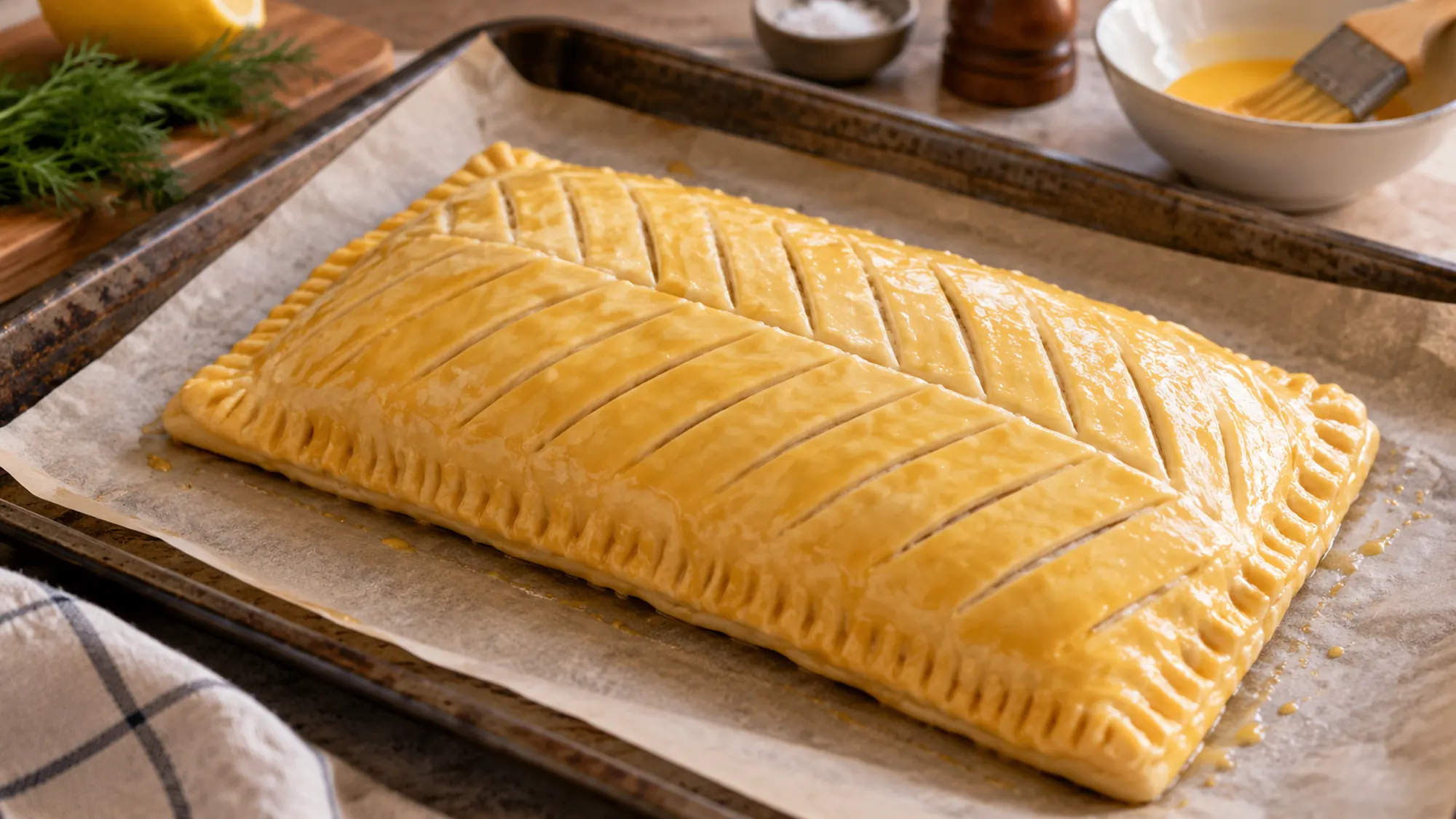
- Roll the chilled dough on a lightly floured surface to a rectangle large enough to enclose the fish. Place salmon centrally. Brush edges with beaten yolk mixed with a teaspoon of water; fold and seal without thick overlapping pastry. Transfer seam-down to a parchment-lined baking sheet.
- Chill the parcel 5 minutes while heating the oven to 425°F (220°C;200°C fan). Brush with remaining egg wash and score a shallow herringbone pattern without cutting through the pastry.
- Bake 25–35 minutes, until golden and the center of the salmon reaches 145°F (63°C); cover loosely if the top browns too quickly. Rest 5 minutes before slicing. Timing depends on the thickness of the fish.
Nutrition
Video
Notes
Tried this recipe?
Let us know how it turned out!Hi, I’m Laura, the voice behind Tastiva. I’ve always believed that eating well should feel enjoyable, comforting, and realistic—not like another complicated rule to follow. I love creating recipes that fit into everyday life, sharing simple nutrition ideas, and finding small ways to make meals feel a little better without losing the pleasure of good food.