
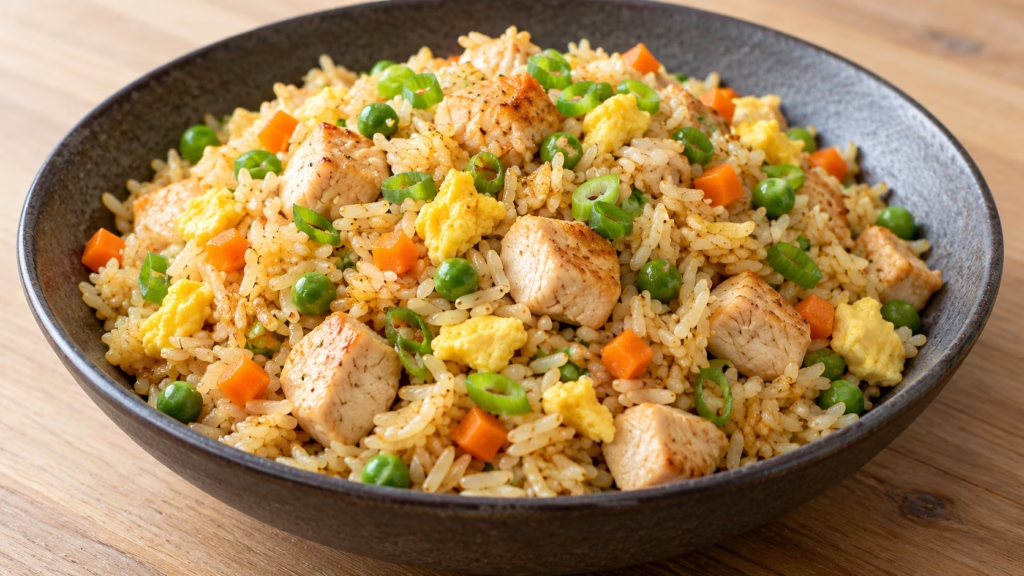
A container of cold rice can look like an unfinished dinner rather than the start of a good one. Chicken fried rice changes that with small pieces of chicken, soft ribbons of egg, and grains that meet a hot pan before the sauce goes in. This version takes about 35 minutes once your rice is cooked and chilled, with garlic and ginger doing the fragrant work.
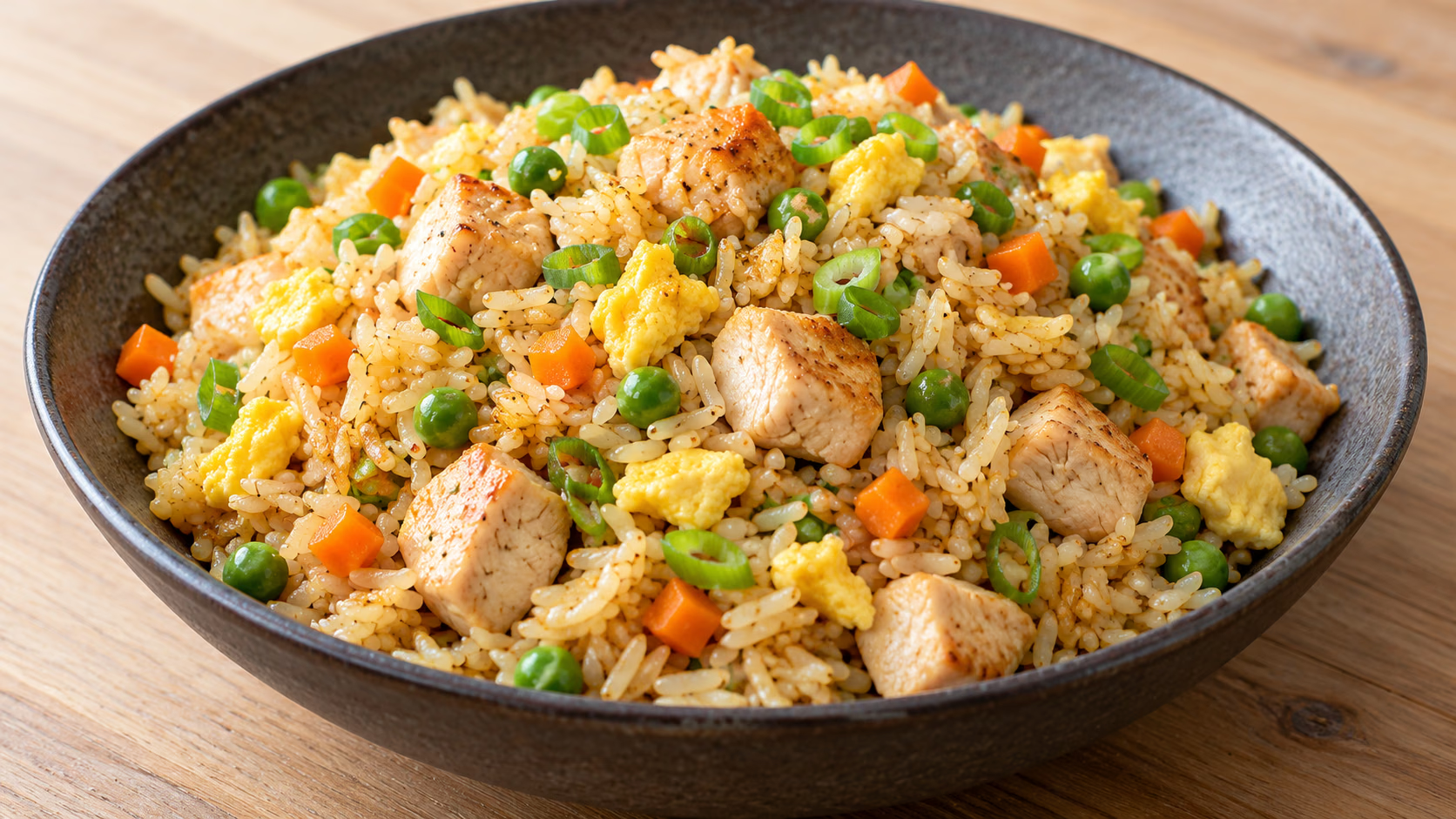
Give the rice room in the pan, and let the chicken and eggs wait their turn. A little space is more useful here than another splash of sauce.
Choose rice for chicken fried rice that stays separate
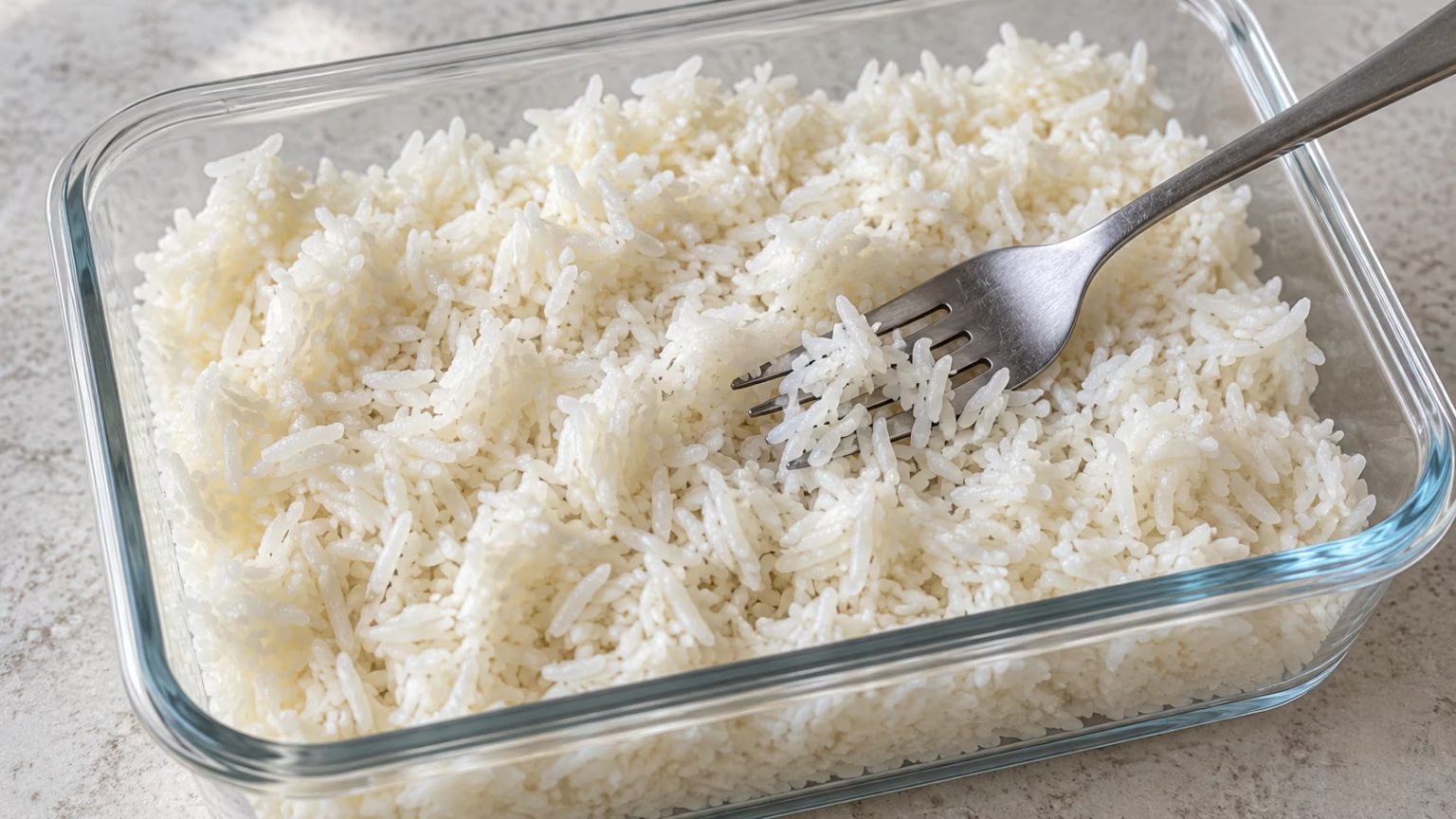
Long-grain white rice is the straightforward choice for this chicken fried rice. Measure it after cooking, chill it promptly, then loosen the clumps before you switch on the stove. I would spend those two minutes on the rice rather than try to break a cold brick apart while the garlic darkens.
- Already chilled rice: Use rice that was cooled and refrigerated safely. Cold does not mean safe if it spent hours on the counter first.
- Freshly cooked rice: Spread it in a shallow container and refrigerate promptly; do not leave it out to dry overnight. Allow additional time for cooking and chilling beyond the recipe’s 35 minutes.
- Brown rice: Substitute the same cooked volume if you prefer a chewier bite. It will look darker and the nutrition estimate will change.
- Very soft rice: Save rice that is wet or breaking down for another meal. More oil cannot rebuild the grains, and aggressive stirring turns softness into paste.
Build flavor without flooding the skillet
Chicken breast keeps this version simple, while eggs make the rice more substantial without needing a heavy sauce. Lower-sodium soy sauce seasons the whole pan; toasted sesame oil goes in at the end for aroma. Neither ingredient needs to turn the rice deep brown to be doing its job.
| Ingredient choice | What changes | Practical adjustment |
|---|---|---|
| Chicken thighs | Richer flavor | Use the same raw weight; cook to 165°F (74°C). |
| Regular soy sauce | More salt | Start with 2 tablespoons; taste before adding more. |
| Frozen vegetables | Extra surface moisture | Thaw in the refrigerator and drain well. |
| Tamari | Different seasoning | For gluten-free needs, choose a labeled gluten-free product. |
I prefer to keep the first batch mild and let people add heat at the table. If you want chili sauce, add a little to your own portion rather than pouring another liquid into the skillet. Check condiment labels when cooking for allergies: this recipe contains egg, soy, sesame, and usually wheat.
Keep a sizzle through each stage
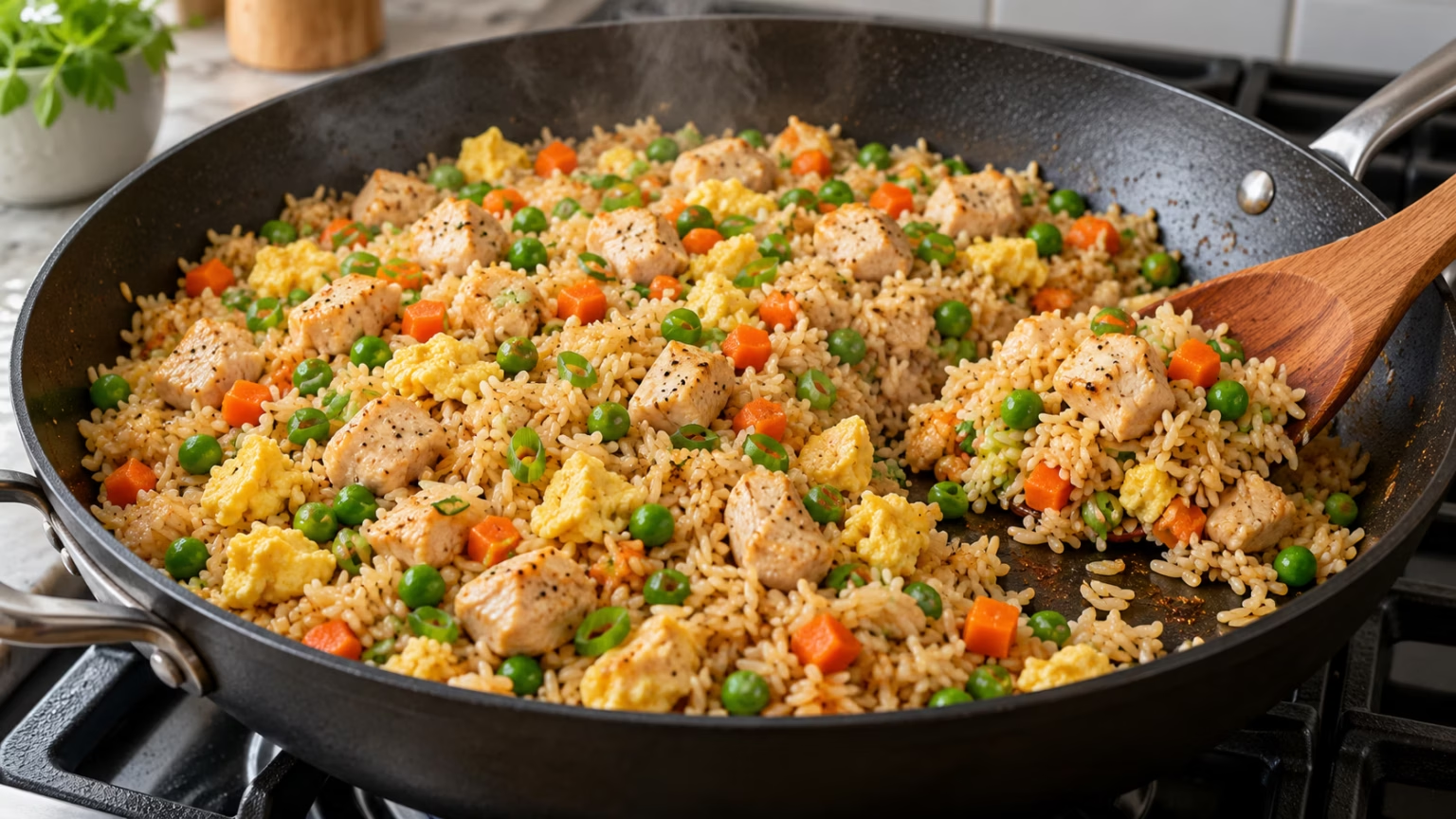
A roomy 12-inch skillet or large wok matters more than theatrical tossing. Cook the chicken and eggs separately, then give the rice access to the pan. You are aiming for distinct, hot grains with a few lightly toasted edges, not a uniformly crunchy crust.
- Prepare before heating: Beat the eggs, measure the sauces, and chop the aromatics first. Once the pan is hot, garlic does not wait politely for a measuring spoon.
- Cook chicken evenly: Keep the pieces about ½ inch across. Check a thick piece with a food thermometer rather than judging safety from its color.
- Watch the vegetables: If a puddle collects, let the moisture evaporate before adding the rice. Otherwise, the next stage starts with steaming instead of frying.
- Pause, then turn: Let the rice sit briefly against the hot surface, then lift and fold. Constant stirring makes good pan contact harder.
- Respect the pan’s capacity: If everything mounds deeply, fry the rice in two portions. A smaller skillet works, but the extra batch can extend the cooking time.
Serve now, and cool leftovers promptly
Spoon the rice into shallow bowls while the scallions are still bright. A cucumber salad or quickly cooked greens can round out the plate, although the chicken, egg, vegetables, and rice already make a satisfying main dish.
- Refrigerate promptly: Divide leftovers into shallow containers within 2 hours, or within 1 hour above 90°F (32°C). Keep the refrigerator at 40°F (4°C) or below.
- Use the oldest ingredient’s clock: USDA advises using refrigerated leftovers within 3–4 days. As a cautious planning rule, count from when your rice was first cooked, not from when you turned it into fried rice.
- Reheat thoroughly: Heat only the portion you need to 165°F (74°C). A small splash of water and a cover help in the microwave; stir and check several spots.
- Do not rescue mishandled rice: FDA explains that Bacillus cereus can produce a heat-resistant toxin in improperly stored food. Reheating does not make rice left out too long reliably safe.
For the storage and temperature guidance, see USDA’s leftovers advice and FDA’s explanation of Bacillus cereus. The important habit is prompt chilling, not waiting for a large pan to reach room temperature.
For another chicken-and-vegetable dinner, try Moo Shu Chicken with cabbage and shiitake mushrooms. Its hoisin-seasoned filling offers a different direction when you would rather skip the rice.
Chicken Fried Rice Recipe

Ingredients
- 1 pound boneless, skinless chicken breast 454 g, cut into ½-inch pieces
- 1/4 teaspoon ground black pepper
- 2 tablespoons neutral cooking oil 30 ml, divided
- 2 large eggs beaten
- 1/2 cup finely diced yellow onion 80 g
- 2 cups frozen peas and carrots 280 g, thawed in the refrigerator and drained
- 3 garlic cloves about 12 g, minced
- 1 tablespoon finely grated fresh ginger 6 g
- 4 cups cooked long-grain white rice 632 g, safely chilled and clumps loosened
- 3 tablespoons lower-sodium soy sauce 45 ml
- 1 teaspoon toasted sesame oil 5 ml
- 1/4 cup thinly sliced scallions 30 g
Equipment
- 12-inch nonstick skillet or large, well-seasoned wok
- wide spatula
- Instant-read food thermometer
- Large clean bowl
Instructions
- Keep the chilled rice refrigerated until you are ready to cook. Pat the chicken dry and season with the black pepper. Have the eggs, vegetables, aromatics, and sauces ready beside the stove.
- Heat the skillet over medium-high heat and add 2 teaspoons of the neutral oil. Spread the chicken in a single layer and cook for about 5–6 minutes, turning occasionally, until the thickest pieces reach 165°F (74°C). Transfer to a clean large bowl.
- Reduce the heat to medium, add 1 teaspoon oil, and pour in the eggs. Gently fold for about 1 minute, until set with no liquid egg remaining. Transfer to the bowl with the cooked chicken.
- Add 1 teaspoon oil and the onion. Cook over medium-high heat for 2 minutes. Add the drained peas and carrots and cook for another 2 minutes, or until hot and any surface moisture has evaporated. Stir in the garlic and ginger for 30 seconds, then transfer the vegetables to the bowl.
- Add the remaining 2 teaspoons oil. Spread the rice across the skillet, leave it undisturbed for about 1 minute, then lift and turn. Continue cooking for 3–4 minutes, breaking up remaining clumps gently, until the grains are hot and some have lightly toasted edges. Work in two portions if the pan is crowded.
- Pour the soy sauce over the rice and fold to distribute. Return the chicken, eggs, and vegetables to the pan and stir for 1–2 minutes, until the mixture reaches 165°F (74°C). Remove from the heat and fold in the sesame oil and scallions. Divide into four portions and serve promptly.
Nutrition
Video
Notes
Tried this recipe?
Let us know how it turned out!Sources
- USDA: Leftovers and Food Safety
- FDA: Bacillus cereus and heat-resistant cereulide
- USDA FoodData Central: ingredient nutrition reference data
Hi, I’m Laura, the voice behind Tastiva. I’ve always believed that eating well should feel enjoyable, comforting, and realistic—not like another complicated rule to follow. I love creating recipes that fit into everyday life, sharing simple nutrition ideas, and finding small ways to make meals feel a little better without losing the pleasure of good food.