
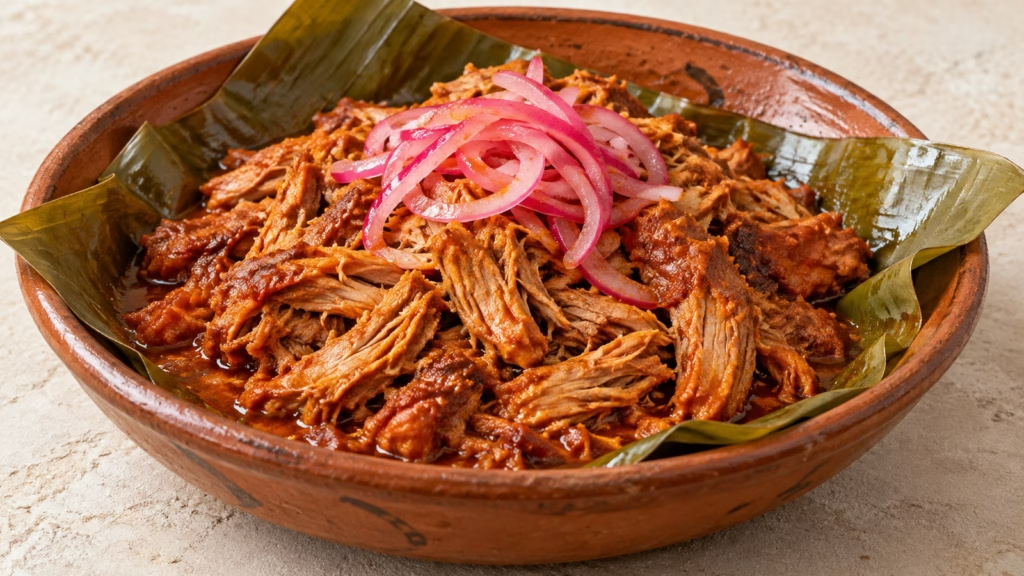
The pork has turned a deep orange-red, the kitchen smells of spices and citrus, and the timer says it is done. Before reaching for the tortillas, try a fork. Cochinita pibil needs meat that separates easily, not simply meat that has spent a certain number of hours in the oven. This home version uses pork shoulder, achiote paste and citrus, with banana leaves wrapped around the meat inside a covered baking dish.
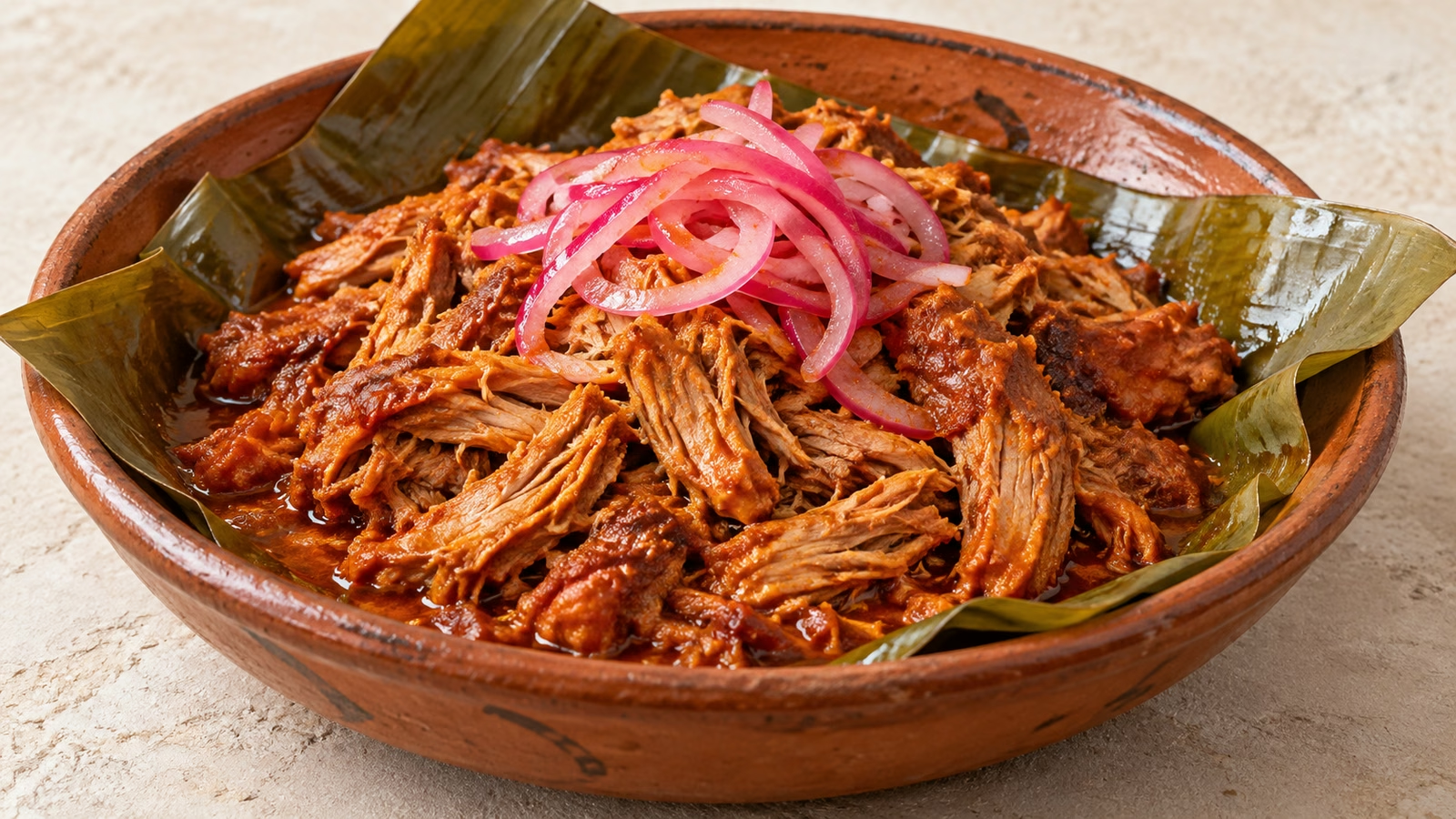
Give the marinade an overnight start, keep the baking dish tightly covered, and wait for the pork to pull apart without a struggle.
Cochinita pibil, adapted for a home oven
Cochinita pibil belongs to Yucatán’s cooking traditions, with achiote, sour orange and slow cooking central to its identity. A traditional pib is an earth oven; a covered kitchen oven is an adaptation, not the same cooking environment. The goal here is to preserve the dish’s recognizable seasoning and tender texture while being clear about the method.
- Pork shoulder: choose a boneless piece with some marbling. Very lean loin does not behave the same way during this long, covered cook.
- Achiote paste: use a seasoned paste, not plain annatto powder. Formulas and salt levels differ, so check the package before measuring the added salt.
- Sour orange: use the juice if available. The card also gives a sweet-orange-and-lime blend as a practical substitute, with a different flavor.
- Banana leaves: look in the frozen section of a Latin American or Asian market. They wrap the meat but are not part of the edible serving.
I would spend the shopping effort on the right pork cut and achiote paste before chasing extra garnishes. Those two choices affect every bite; a long topping list cannot compensate for dry meat.
Build the marinade and leave room for time
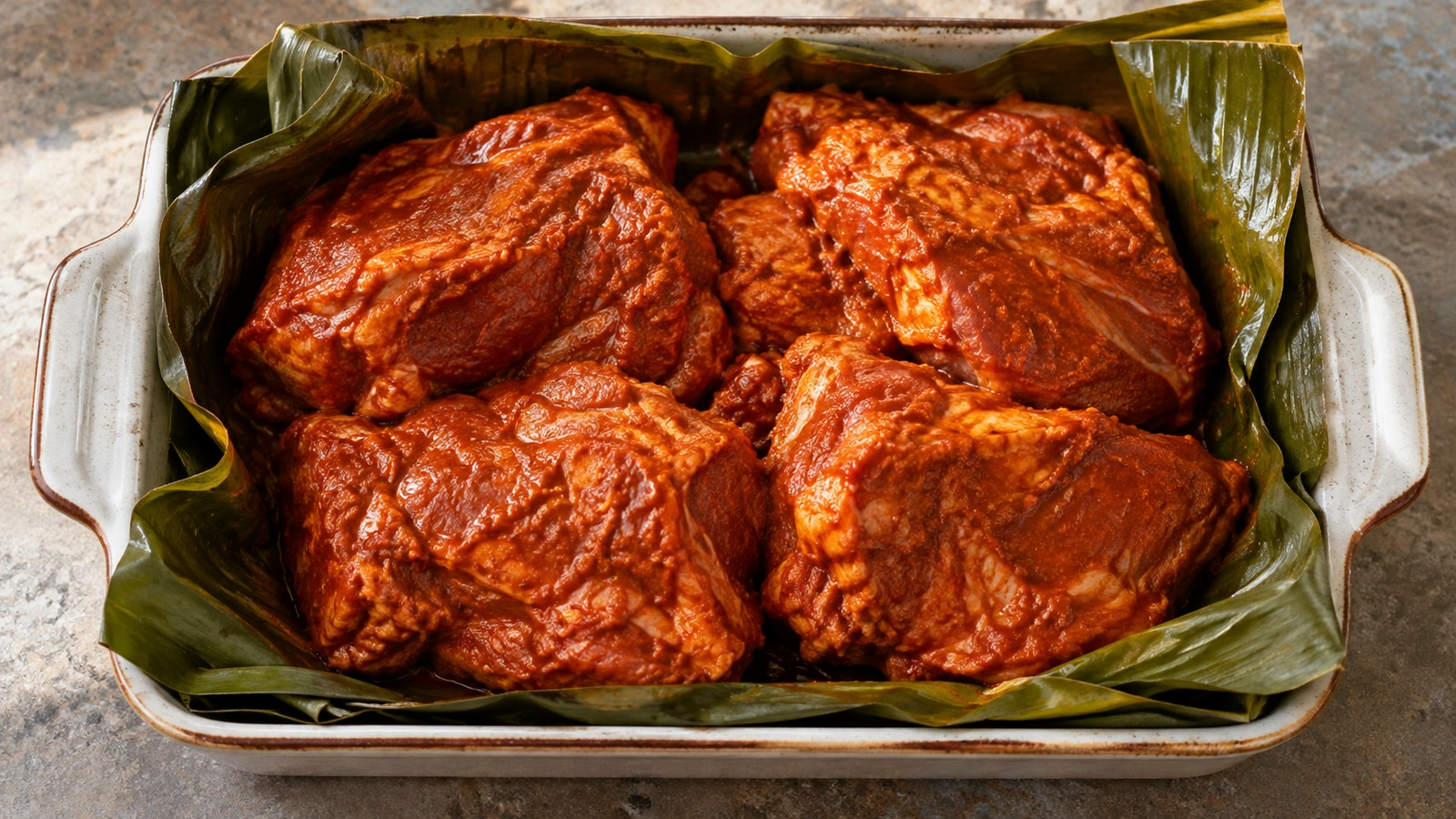
Blend the paste thoroughly with the citrus, garlic, oregano, cumin and water so no dense lumps of seasoning remain. Coat four to six large pieces of pork in a nonreactive container, cover and refrigerate for 8 hours. This is useful overnight planning, not a reason to leave raw pork on the counter.
- Keep it cold: marinate at 40°F (4°C) or colder. Put the container where it cannot drip onto foods that will be eaten without cooking.
- Measure the substitute: use 225 ml sweet orange juice plus 75 ml lime juice for the stated 300 ml total. Adding only sweet orange changes the balance.
- Account for the paste: if yours is particularly salty, reduce the 3 g added salt. The nutrition estimate uses the named product information in the notes.
- Plan the full window: allow 25 minutes of preparation, about 3 to 3 1/2 hours in the oven, an overnight marinade and a 15-minute rest.
Large pieces are easier to wrap and keep moist than a pan of tiny cubes. Set the baking dish and leaves out before transferring the marinated pork so you are not rearranging the kitchen with dripping tongs.
Tenderness matters more than the timer
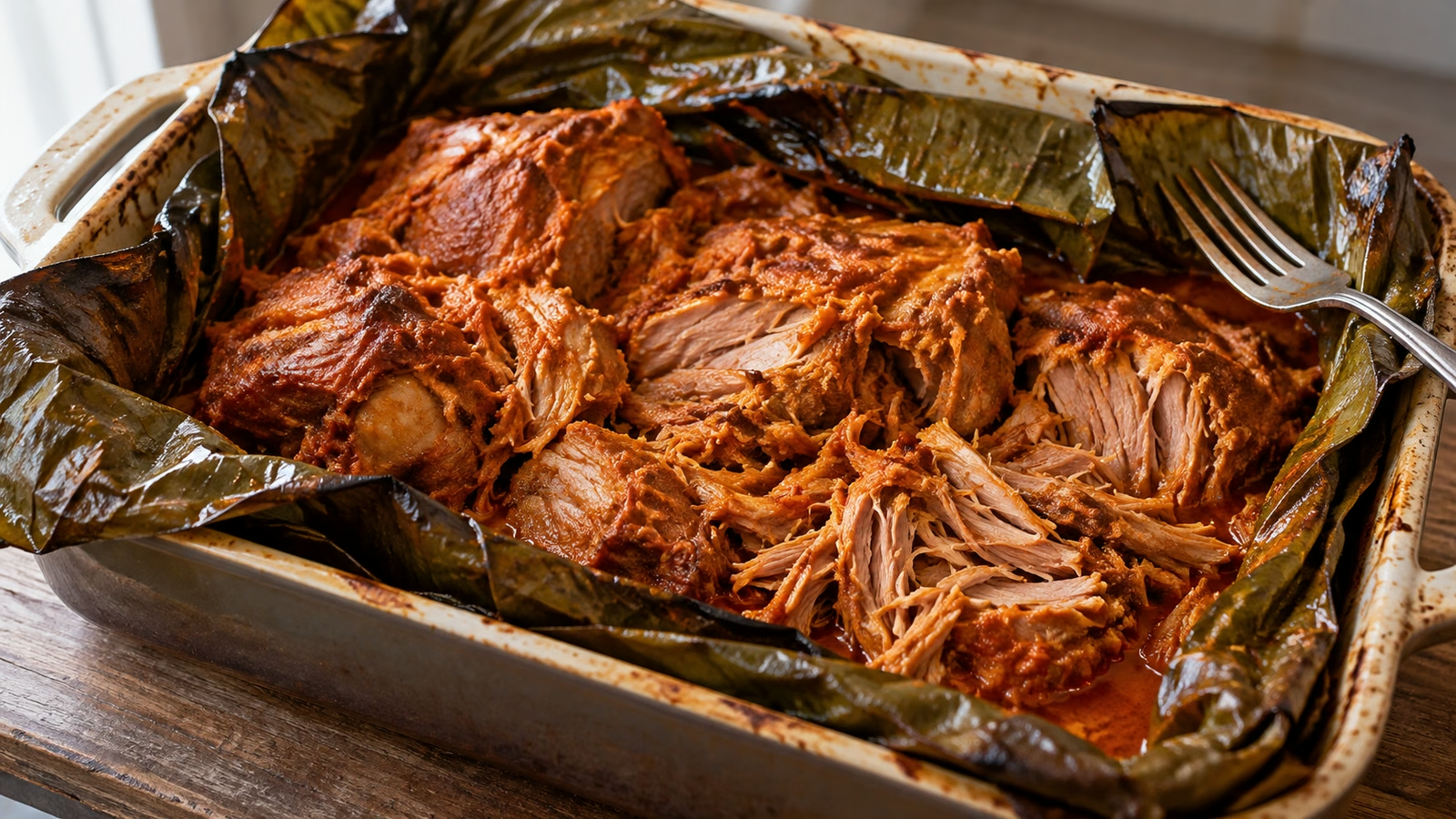
Soften the banana leaves briefly on a hot, dry skillet until flexible, then line a deep baking dish with enough overhang to fold over the meat. Add all the marinade, close the leaves and cover the dish tightly. At 340°F (170°C), steady enclosed heat does most of the work.
- Begin checking at about 3 hours. Open the cover away from your face and look for some liquid remaining in the bottom.
- Press a fork into a thick piece. It should separate readily; firm resistance means the pork needs more time, even if the scheduled cooking period is over.
- If needed, re-cover and continue in 20- to 30-minute intervals. Add a little hot water if the pan is drying out rather than letting the marinade scorch.
- Rest the cooked pork, covered, for 15 minutes. Shred it and fold the strands back through the cooking juices before serving.
The safe minimum for pork roasts is 145°F (63°C) plus a 3-minute rest, but shoulder needs substantially more cooking to shred. Safety temperature and the texture you want answer different questions. I would check both rather than ask the clock to settle the matter.
Serve with a sharp finish and save the juices
Quick-pickled red onion gives the rich pork a useful contrast. The optional onion mixture rests in the refrigerator while the pork cooks; it is a refrigerated quick pickle, not a shelf-stable preserve. Drain a small forkful for each portion and offer tortillas and habanero sauce separately.
- Keep toppings restrained: start with pork, its juices and onion. Extra sauce is easier to add at the table than remove from an entire serving.
- For another slow-cooked meal: barbacoa-style beef uses a different seasoning profile and a cut suited to a long braise.
- Cool promptly: divide pork and juices into shallow containers and refrigerate within 2 hours, or 1 hour above 90°F (32°C).
- Reheat covered: keep leftovers at 40°F (4°C) or below for 3 to 4 days. Warm with their juices to 165°F (74°C), stirring for even heating.
The nutrition estimate covers one-eighth of the pork and all marinade, without the optional onions, tortillas or sauce. Some nutrient fields are omitted because the achiote manufacturer’s information does not establish them; a blank does not mean zero.
Cochinita Pibil Recipe

Ingredients
- 1200 g boneless pork shoulder about 2 lb 10 oz, with marbling; cut into 4 to 6 large pieces
- 80 g seasoned achiote paste about 2.8 oz; check salt content
- 300 ml sour orange juice about 1 1/4 cups; or 225 ml sweet orange juice plus 75 ml lime juice
- 12 g garlic about 4 cloves
- 1 g dried oregano about 1 teaspoon
- 1 g ground cumin about 1/2 teaspoon
- 0.5 g ground black pepper about 1/4 teaspoon
- 3 g table salt about 1/2 teaspoon; reduce with salty achiote paste
- 100 ml water about 1/3 cup plus 1 tablespoon
- 2 large banana leaves enough to wrap the pork; not eaten
- 150 g red onion thinly sliced
- 60 ml apple cider vinegar about 1/4 cup
- 60 ml water about 1/4 cup
- 1 g table salt about 1/6 teaspoon
Equipment
- Blender
- Nonreactive covered marinating container
- Deep baking dish with tight-fitting cover
- Large dry skillet
- Food thermometer
- Two forks
Instructions
- Blend achiote paste, citrus juice, garlic, oregano, cumin, pepper, 3 g salt and 100 ml water until smooth. Coat the pork in a nonreactive container, cover and refrigerate at 40°F (4°C) or below for 8 hours.
- Heat the oven to 340°F (170°C). Soften banana leaves briefly over a hot, dry skillet until they bend without splitting. Line a deep baking dish, leaving enough overhang to wrap the meat. Add pork and all the marinade.
- Fold leaves over the pork and cover the dish tightly. Bake for about 3 to 3 1/2 hours, beginning to check at 3 hours. Open carefully away from your face; there should be some liquid in the pan and the meat should separate easily with a fork.
- If still firm, re-cover and continue in 20- to 30-minute intervals. Add a little hot water if the bottom dries out. Pork must exceed 145°F (63°C) and rest at least 3 minutes for safety, but shoulder needs further cooking to become shreddable; use fork tenderness as the texture test.
- Rest covered for 15 minutes. Shred with two forks and fold the pork through its juices. Remove banana leaves before eating.
- While the pork bakes, combine red onion, vinegar, 60 ml water and 1 g salt. Cover and refrigerate at least 30 minutes. This is a quick refrigerated pickle, not a shelf-stable preserve.
- Serve pork with a little drained pickled onion. Offer warm tortillas and habanero sauce separately if desired.
Nutrition
Notes
Tried this recipe?
Let us know how it turned out!Sources
- Larousse Cocina: cochinita pibil and Yucatán tradition
- FoodSafety.gov: pork cooking temperatures
- USDA: safe leftover handling
- USDA FoodData Central: ingredient composition
- El Yucateco: achiote paste product data
Hi, I’m Laura, the voice behind Tastiva. I’ve always believed that eating well should feel enjoyable, comforting, and realistic—not like another complicated rule to follow. I love creating recipes that fit into everyday life, sharing simple nutrition ideas, and finding small ways to make meals feel a little better without losing the pleasure of good food.