
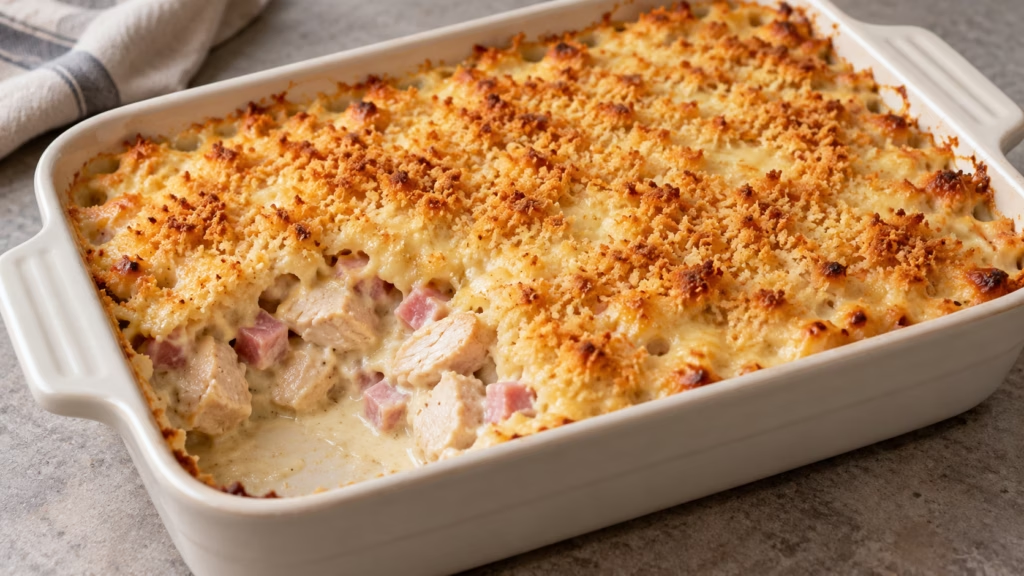
The appealing part of chicken cordon bleu is the combination: tender chicken, salty ham, melted Swiss and a crisp coating. The less appealing part on a busy evening is persuading a stuffed chicken breast to stay neatly rolled. This chicken cordon bleu casserole skips that negotiation, folding cooked chicken and ham into a simple Dijon sauce before adding cheese and buttery breadcrumbs.
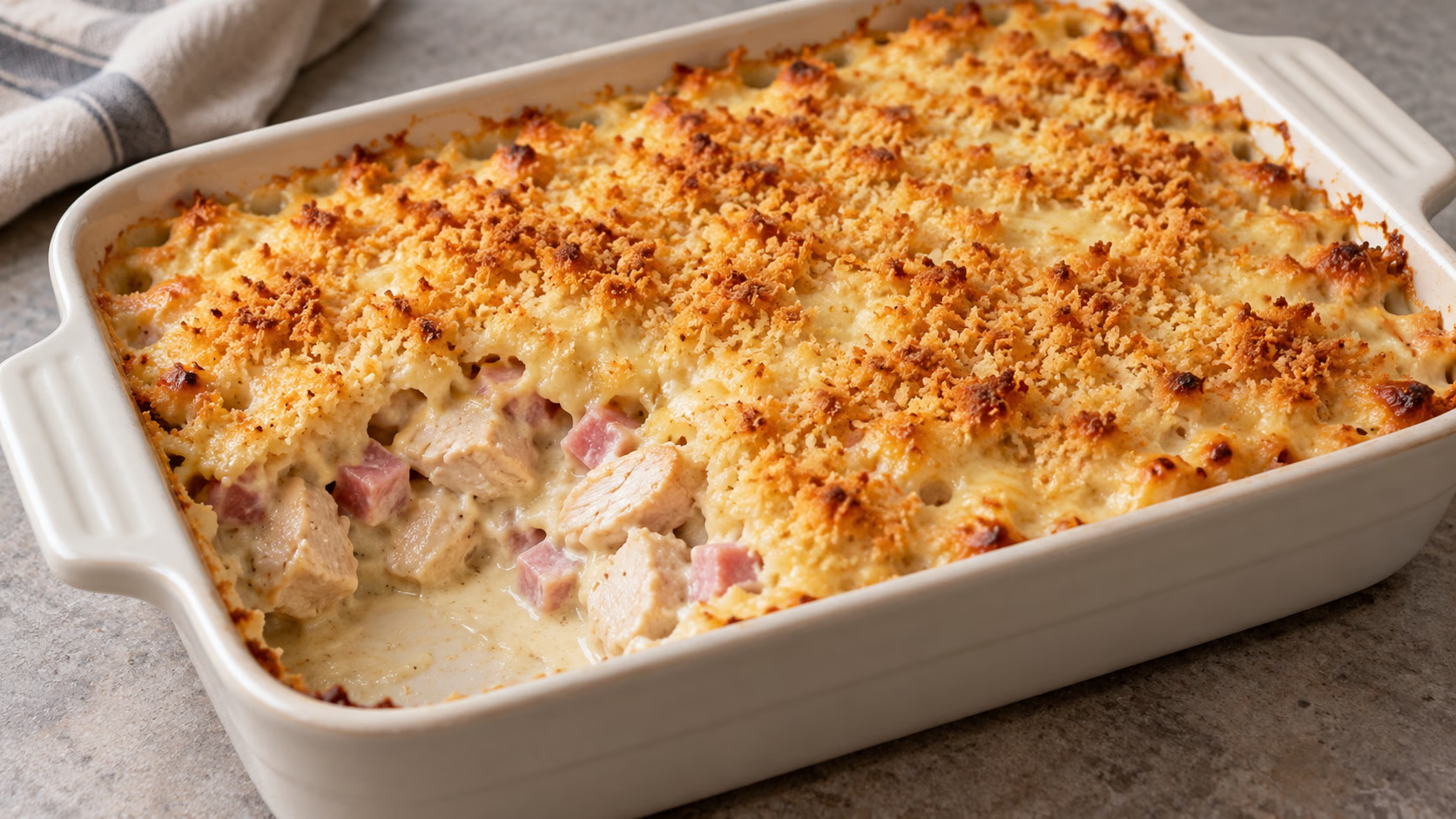
Keep the chicken already cooked, the sauce pourable and the crumbs on top. That is how this shortcut keeps its comforting center and crisp finish.
Build chicken cordon bleu casserole around cooked chicken
This is a cooked-chicken casserole, not a dish for raw chicken pieces. Bite-size chunks hold their shape better than very fine shreds, which can disappear into the sauce. I would choose plain cooked breast meat, then let the ham and mustard supply the stronger seasoning.
- Measure the meat after cooking. Four loosely filled cups are about 560 g, but a scale is more consistent than packing shredded meat into a cup. Remove skin, bones and cartilage first.
- Cut the ham smaller than the chicken. Small dice distribute its salty flavor instead of leaving a few large, chewy pieces in each serving. Fully cooked ham is essential here.
- Use Swiss as the main cheese. Its nutty flavor keeps the dish recognizable. Mild Gruyère is an alternative, although both flavor and nutrition will change.
- Keep the base free of pasta. This formula has no allowance for noodles or rice soaking up sauce. Serve either alongside it rather than stirring a dry starch into the baking dish.
A skinless rotisserie chicken can be convenient, but taste the sauce before adding optional salt. Seasoned chicken, ham and cheese already bring salt with them; more is not automatically better.
A sauce that coats without turning gluey
The sauce begins with a roux, simply flour cooked in butter, followed by milk and water. Its job is to coat the meat while staying loose enough to settle between the pieces. I prefer this to a stiff cheese sauce because the Swiss already has its own layer.
- Add liquid gradually. Whisk in a small splash first to smooth the flour mixture, then add the rest in stages. Scrape the saucepan corners, where little flour pockets like to hide.
- Stop at a light coating. After a gentle simmer, the sauce should cover the back of a spoon but still pour readily. It will thicken further in the oven and during the rest.
- Add Dijon after thickening. This keeps its amount easy to judge. The measured two tablespoons give the creamy filling a clear mustard note without adding a separate sauce at the table.
Whole milk is the starting point for this formula. Lower-fat milk makes a leaner-tasting sauce; heavy cream makes it much richer and is not a necessary upgrade. For a slightly looser finish, stir a tablespoon or two of water into an overly thick sauce before assembly.
Protect the crumb topping while the center heats
Mixing panko with melted butter coats the uneven flakes more evenly than scattering dry crumbs over the dish. Spread them in a light layer rather than pressing them into a hard cap. The casserole should remain spoonable, not slice like a loaf.
| What you notice | What to do |
|---|---|
| Crumbs brown before the middle is hot | Loosely tent with foil and continue baking. |
| Top is pale, center is hot | Give it a few more uncovered minutes and watch closely. |
| Filling looks loose straight from the oven | Rest 10 minutes before spooning. |
| Cold assembly needs longer | Follow the center temperature, not the clock alone. |
Bake at 375°F (190°C) and check for 165°F (74°C) in the center with a food thermometer. Bubbling at the edges is helpful, but it does not establish the temperature in the middle. Keep the probe away from the hot baking dish itself.
Serve something crisp beside it and handle leftovers promptly
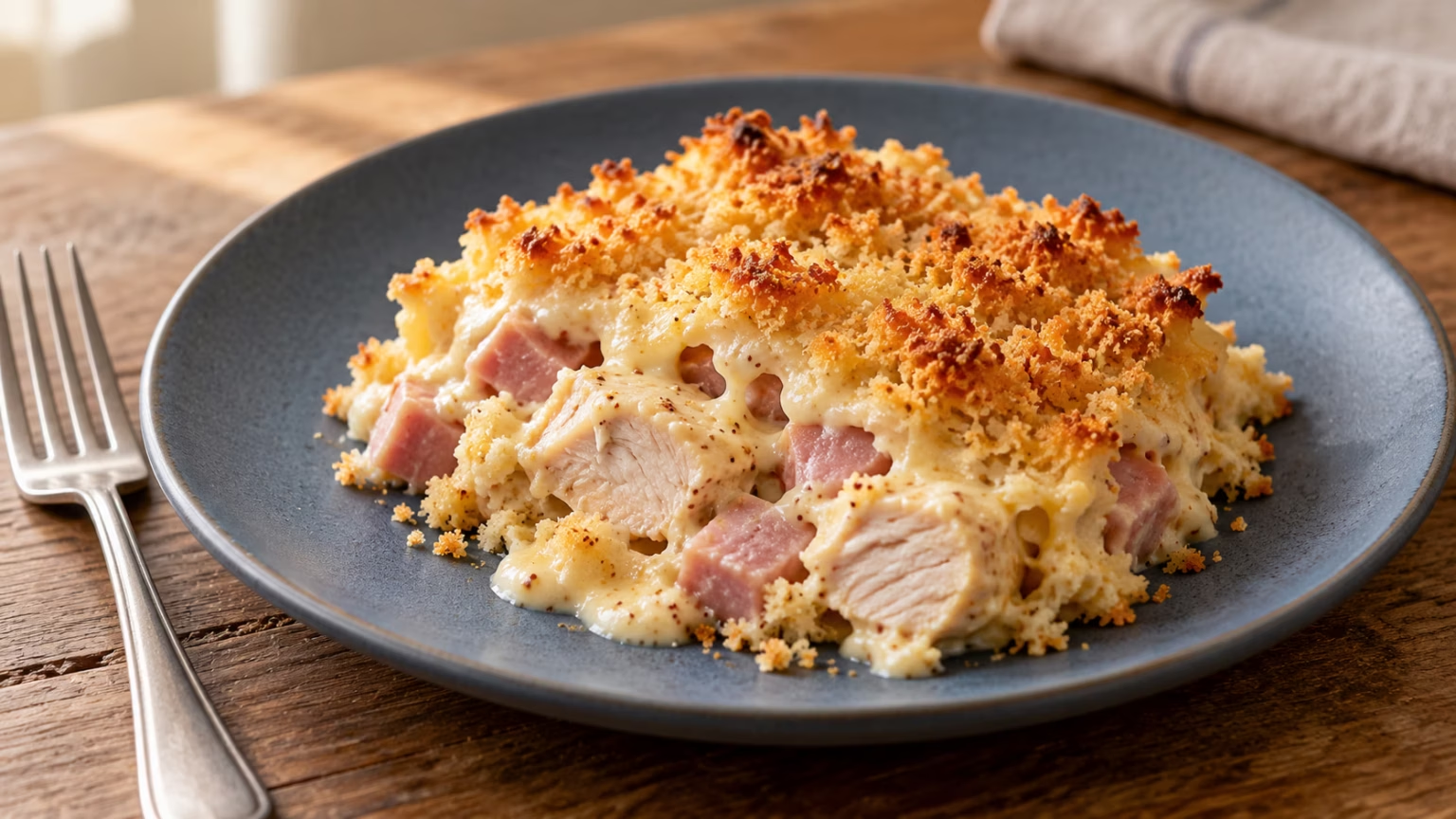
With chicken, ham, sauce and cheese already sharing the dish, I would keep the side simple: steamed green beans, a sharp green salad or fresh cucumber. For a more assertive crunchy option, our sesame-garlic cabbage salad provides contrast; use a modest portion because its dressing also contributes salt.
- For a head start: chop the cooked chicken and ham and grate the cheese, then refrigerate them separately. Make the sauce and buttered crumbs when ready to assemble.
- Refrigerate promptly: divide leftovers into shallow containers within two hours, or one hour above 90°F (32°C). Keep the refrigerator at 40°F (4°C) or colder.
- Use within three to four days: if the chicken or ham was already leftover, count from its original cooking date rather than restarting its storage time.
- Reheat to 165°F (74°C): cover to retain moisture and add a small splash of water if needed. The crumbs soften in storage; the microwave is convenient, not a promise of renewed crunch.
The card makes six portions. Its calorie estimate covers the casserole alone, not sides, and will vary especially with the ham and cheese you choose.
Chicken Cordon Bleu Casserole Recipe

Ingredients
- 4 cups cooked skinless chicken breast 560 g, cut into bite-size pieces; do not use raw chicken
- 7 ounces fully cooked ham 200 g, diced small
- 1 1/2 cups shredded Swiss cheese 168 g
- 3 tablespoons unsalted butter 42 g
- 1/4 cup all-purpose flour 30 g
- 2 cups whole milk 480 ml, approximately 488 g
- 1/2 cup water 120 ml
- 2 tablespoons Dijon mustard 30 g
- salt and black pepper optional, to taste; ham and cheese already add salt
- 1 cup plain panko breadcrumbs 60 g
- 2 tablespoons unsalted butter 28 g, melted
Equipment
- 9 x 13-inch baking dish about 3 quarts
- medium saucepan
- Whisk
- Food thermometer
Instructions
- Heat the oven to 375°F (190°C). Have a 9 × 13-inch, approximately 3-quart baking dish ready. Cut the cooked chicken and fully cooked ham into bite-size pieces, keeping the ham dice smaller. Spread both in the dish.
- Melt 3 tablespoons butter in a medium saucepan over medium heat. Whisk in the flour and cook, whisking, for 1 minute without letting it brown. Whisk in the milk gradually, starting with a small splash and smoothing the paste before each addition. Whisk in the water.
- Bring to a gentle simmer, whisking often, and cook about 4–6 minutes until the sauce lightly coats a spoon but remains pourable. Remove from the heat and stir in the Dijon. Taste and add optional salt and pepper only if needed. If the sauce has become too thick to pour, whisk in 1–2 tablespoons water.
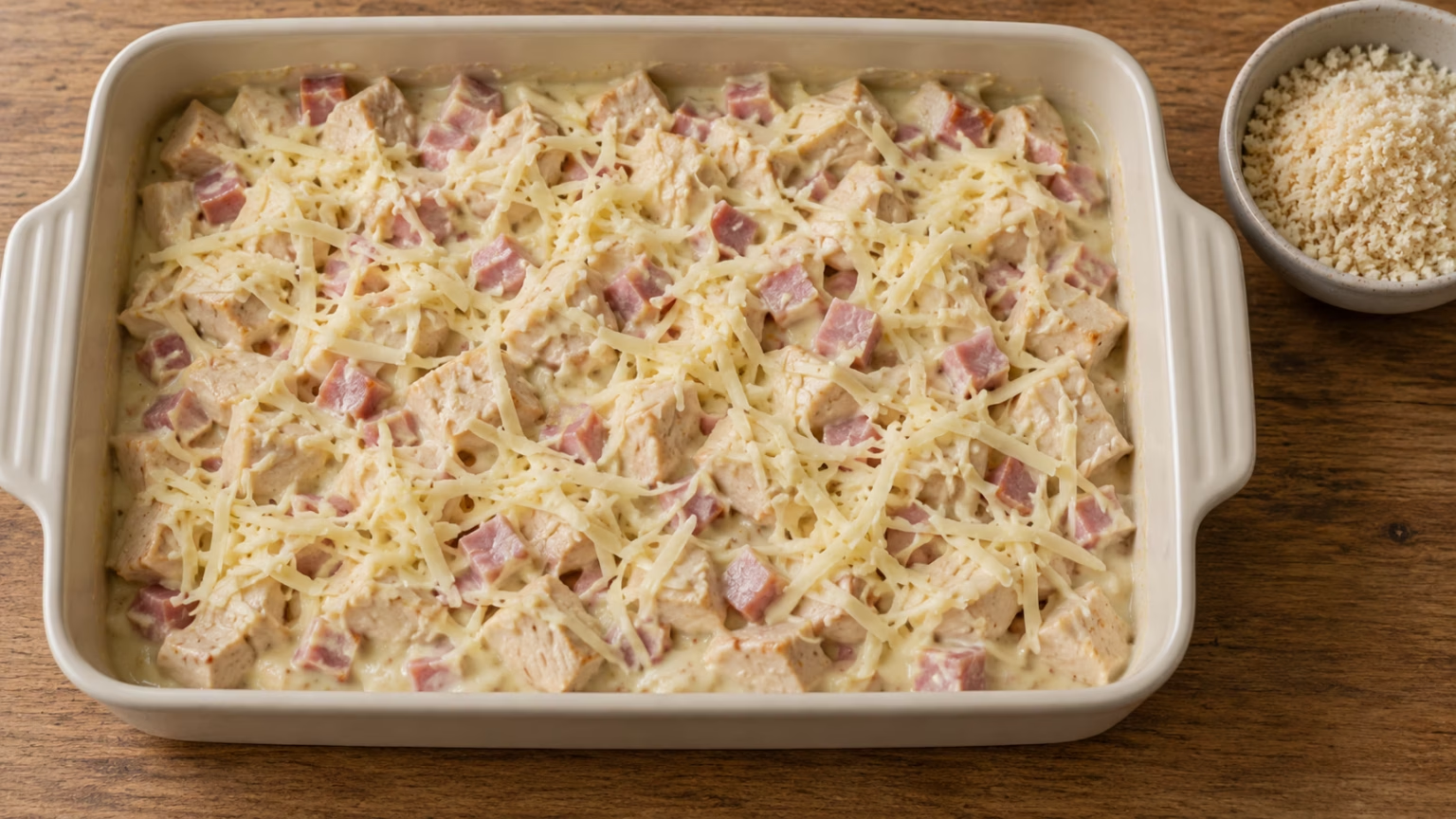
- Pour the sauce over the chicken and ham. Gently fold so all the meat is coated and spread into an even layer. Scatter the Swiss over the top.
- Combine the panko with the remaining 2 tablespoons melted butter in a small bowl. Scatter evenly over the cheese without pressing down.
- Bake uncovered for about 30–35 minutes, until the center reaches 165°F (74°C) on a food thermometer and the topping is golden. Check around 25 minutes; tent loosely with foil if the crumbs brown before the center is hot. Chilled ingredients may need additional time.
- Rest for 10 minutes, then spoon into six portions. Serve with vegetables or salad if desired.
Nutrition
Video
Notes
Tried this recipe?
Let us know how it turned out!Sources
- Laura Vitale: cooked-chicken casserole method and video companion
- USDA: safe storage and reheating of leftovers
- USDA-derived cooked chicken nutrition; whole milk and Swiss cheese data
- Ham, butter, flour, panko and Dijon label references
Hi, I’m Laura, the voice behind Tastiva. I’ve always believed that eating well should feel enjoyable, comforting, and realistic—not like another complicated rule to follow. I love creating recipes that fit into everyday life, sharing simple nutrition ideas, and finding small ways to make meals feel a little better without losing the pleasure of good food.