
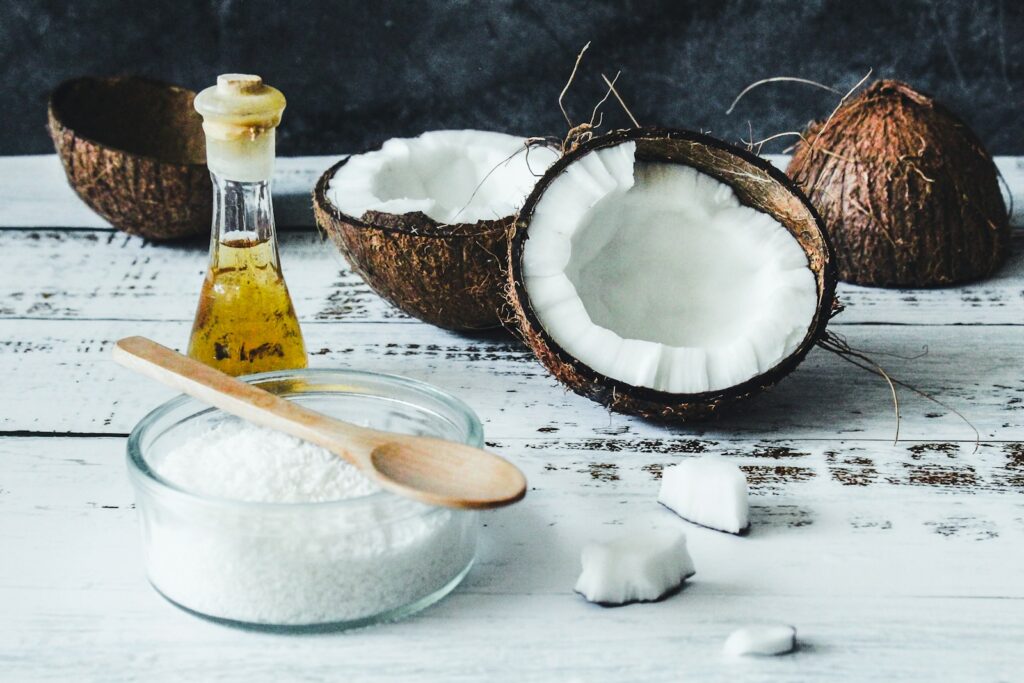
A clear bottle of fractionated coconut oil can look perfectly at home beside the cooking oils, even when it belongs in the bathroom. Fractionated coconut oil has been processed to separate components of coconut oil, often leaving a liquid product rich in selected medium-chain fats. Whether you can eat it depends on the actual product. A cosmetic carrier oil is not a cooking ingredient just because its source is coconut.
The most important words on this bottle describe its intended use, not its tropical origin.
Why fractionated coconut oil stays liquid
Ordinary coconut oil contains a mixture of fats. Fractionation separates portions of that mixture, changing the finished product’s composition and physical behavior. Many fractionated products emphasize caprylic and capric triglycerides, commonly described as C8 and C10 fats. The number refers to the carbon-chain length, not a quality score.
The terms fractionated coconut oil and MCT oil sometimes overlap in marketing, but they don’t establish identical ingredients or uses. MCT stands for medium-chain triglycerides. An MCT product may be derived from coconut, palm kernel oil, or both, and its precise blend varies. Check the manufacturer’s description rather than assuming every clear liquid coconut product is the same.
I’d make the intended-use check before considering any claims about energy or wellness. A beautiful bottle can still be the wrong bottle for your smoothie.
Cosmetic oil, food oil, and MCT products compared
The distinction is easy to see within one manufacturer’s range. NOW Solutions sells a liquid coconut oil for skin, hair, and massage use. NOW Sports also sells an MCT oil with a Supplement Facts panel and oral-use directions. Those product pages support different uses; the shared coconut connection doesn’t erase that boundary.
| Product in your hand | What to look for | Kitchen decision |
|---|---|---|
| Cosmetic fractionated coconut oil | Skin, hair, massage, or carrier-oil directions | Keep it out of food |
| Edible MCT oil | Explicit oral-use directions and the appropriate nutrition or supplement panel | Follow that product’s instructions and cautions |
| Coconut cooking oil | Clear food labeling and cooking guidance | Use only for the applications described |
| Unclear or decanted oil | Missing original label or uncertain contents | Don’t guess that it is edible |
“Pure,” “natural,” and “100% coconut” do not replace an edible-use statement. Neither does a familiar-sounding ingredient name. If the bottle doesn’t clearly support food use, ask the manufacturer or choose an unmistakably food-labeled alternative.
What changes if an oil is labeled for eating?
An edible label answers one question, not every cooking question. Check the intended temperature and applications as well. For example, NOW’s MCT oil directions specifically advise against frying because of its low smoke point. That warning should not be replaced with a blanket claim that all coconut-derived oils are suitable for high heat.
An edible MCT oil is also still a concentrated fat. The current NOW product panel lists 130 calories and 14 grams of fat per tablespoon, all listed as saturated fat. Those values describe that product, not every bottle sold under an MCT or fractionated label. Read yours before making a comparison.
- Don’t assume a liquid appearance means low saturated fat.
- Don’t add oil to coffee or shakes expecting it to replace the protein, fiber, and variety of a meal.
- Follow oral-use cautions, including advice to consult a clinician when pregnant, nursing, taking medicines, or managing a medical condition.
- Be aware that MCT products can cause gastrointestinal upset; more is not automatically better.
- Keep cosmetic bottles separately stored so another person doesn’t mistake them for cooking ingredients.
Choose a practical alternative for your actual meal
If your goal is simply a neutral dressing or an everyday sauté, you don’t have to buy a specialized product. Choose a food-labeled oil appropriate for the recipe and your needs. The American Heart Association’s cooking-oil guidance offers several common liquid-oil options, including olive, canola, soybean, and sunflower.
For a recipe that relies on solid coconut oil, a permanently liquid fractionated product may change the texture. Treat that as a formulation question rather than assuming a shared plant source makes a direct substitution work. Coconut oil, coconut milk, and cream of coconut also serve different roles; the last is a sweetened product, not another name for the oil.
My straightforward shopping rule is to begin with the dish. If the recipe needs a cooking oil, buy a cooking oil. If you’re considering an MCT supplement for a specific health goal, discuss that goal with an appropriate clinician instead of letting the product’s marketing make the decision. And if the bottle is for massage, let it stay very happily out of dinner.
Sources
- NOW Solutions: Liquid coconut oil and intended topical uses
- NOW Sports: MCT oil ingredients, nutrition, directions, and cautions
- American Heart Association: Choosing cooking oils

Hi, I’m Laura, the voice behind Tastiva. I’ve always believed that eating well should feel enjoyable, comforting, and realistic—not like another complicated rule to follow. I love creating recipes that fit into everyday life, sharing simple nutrition ideas, and finding small ways to make meals feel a little better without losing the pleasure of good food.