
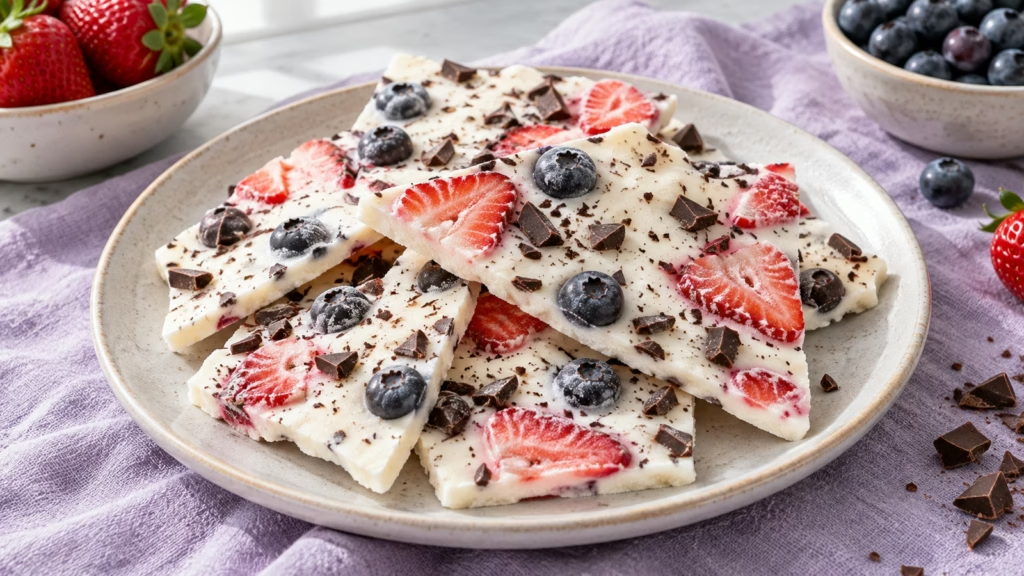
The yogurt is mixed, the berries are ready, and then the baking tray will not fit in the freezer. Frozen yogurt bark is simple, but a little planning makes it much easier: clear a level space first, spread the yogurt thinly, and keep the toppings small. You will get cold, tangy pieces to pick up and eat before they soften.
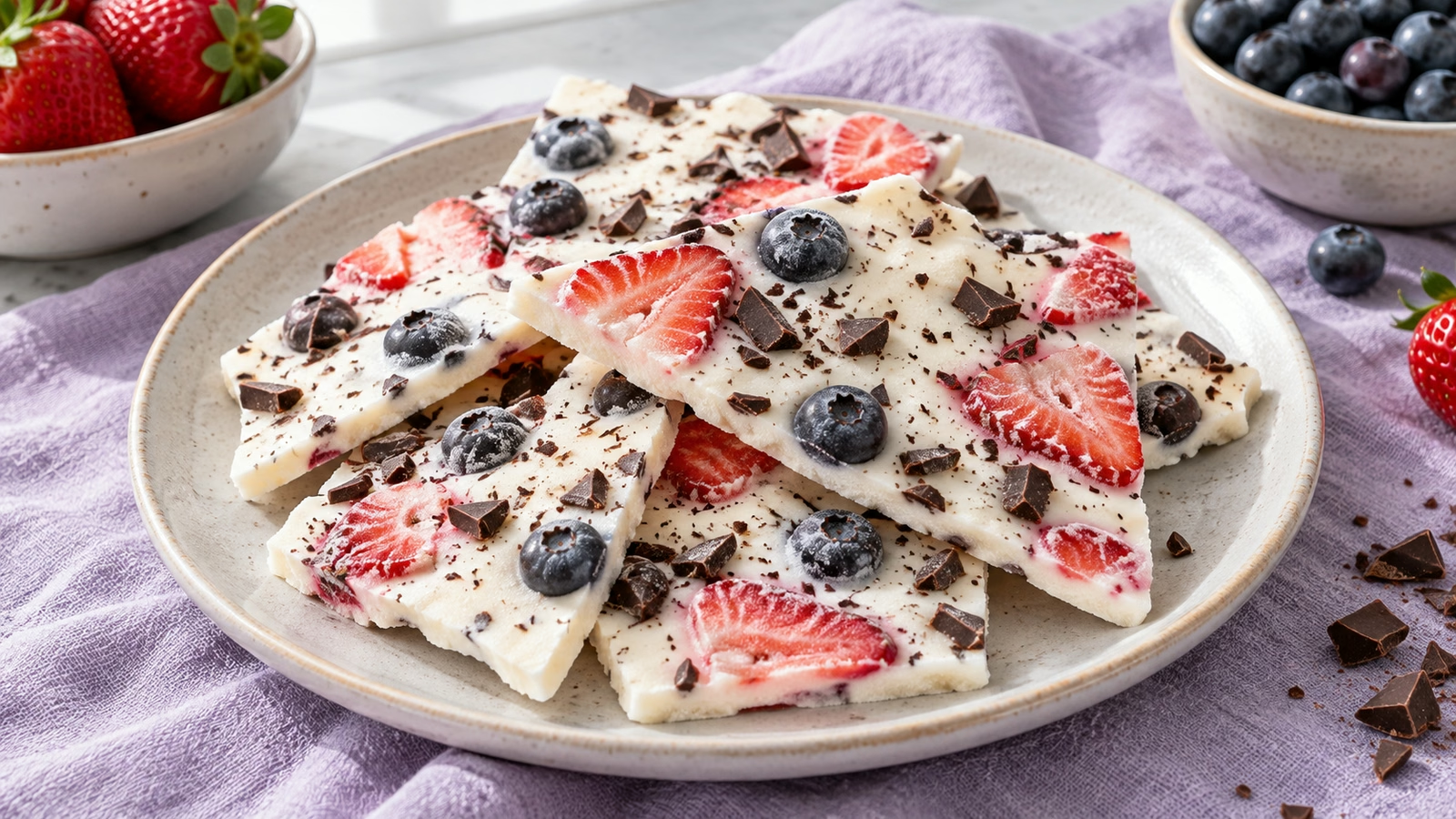
A thin yogurt layer and small pieces of fruit make frozen bark easier to break and more comfortable to bite.
What frozen yogurt bark is, and what it is not
Frozen yogurt bark is sweetened yogurt spread on parchment, topped and frozen into a sheet. It breaks into irregular pieces, more like a brittle freezer snack than a scoop of ice cream. There is no churning, and the texture stays firmer and more icy than a creamy frozen dessert designed for scooping.
The format is an established social-media favorite: Parade discussed the yogurt-bark trend in 2022 and included it in its July 2026 viral-recipe roundup. I would make it when a small freezer treat sounds useful, not when dessert needs to sit on a buffet table.
- Flavor: yogurt remains tangy, with maple syrup and vanilla rounding out the base.
- Texture: thin pieces are easier to bite than a deep slab. A larger layer is not automatically a more generous serving.
- Equipment: a tray, parchment, bowl and spoon do most of the work. An offset spatula is helpful but optional.
- Timing: allow at least three hours for freezing, and use firmness rather than the clock as the final check.
Choose thick yogurt and modest toppings
Start with plain whole-milk Greek yogurt that tastes good to you before freezing. Stir it until uniform, including any small amount of separated whey. A thin, drinkable yogurt gives a different result, and swapping in a flavored product changes sweetness before you add the maple syrup.
I prefer strawberries sliced thinly and blueberries scattered with some space between them. Large frozen fruit chunks can be awkward to bite. Chopped chocolate adds small pockets of richness, but a thick blanket makes the yogurt harder to break cleanly and hides the fruit.
- Strawberries: wash, dry and remove the tops before slicing. Surface water adds icy patches.
- Blueberries: use small berries or halve very large ones. Press them lightly into the yogurt so they stay attached.
- Chocolate: chop it finely rather than adding large squares. A little reaches more bites when the pieces are small.
- Different yogurt: lower-fat or dairy-free products vary in thickness and freezing texture. Treat the swap as a variation, not an identical result.
- Prefer a refrigerator dessert? Our yogurt biscuit cups stay spoonable and use chilling for a different purpose.
Spread a thin sheet and freeze it level
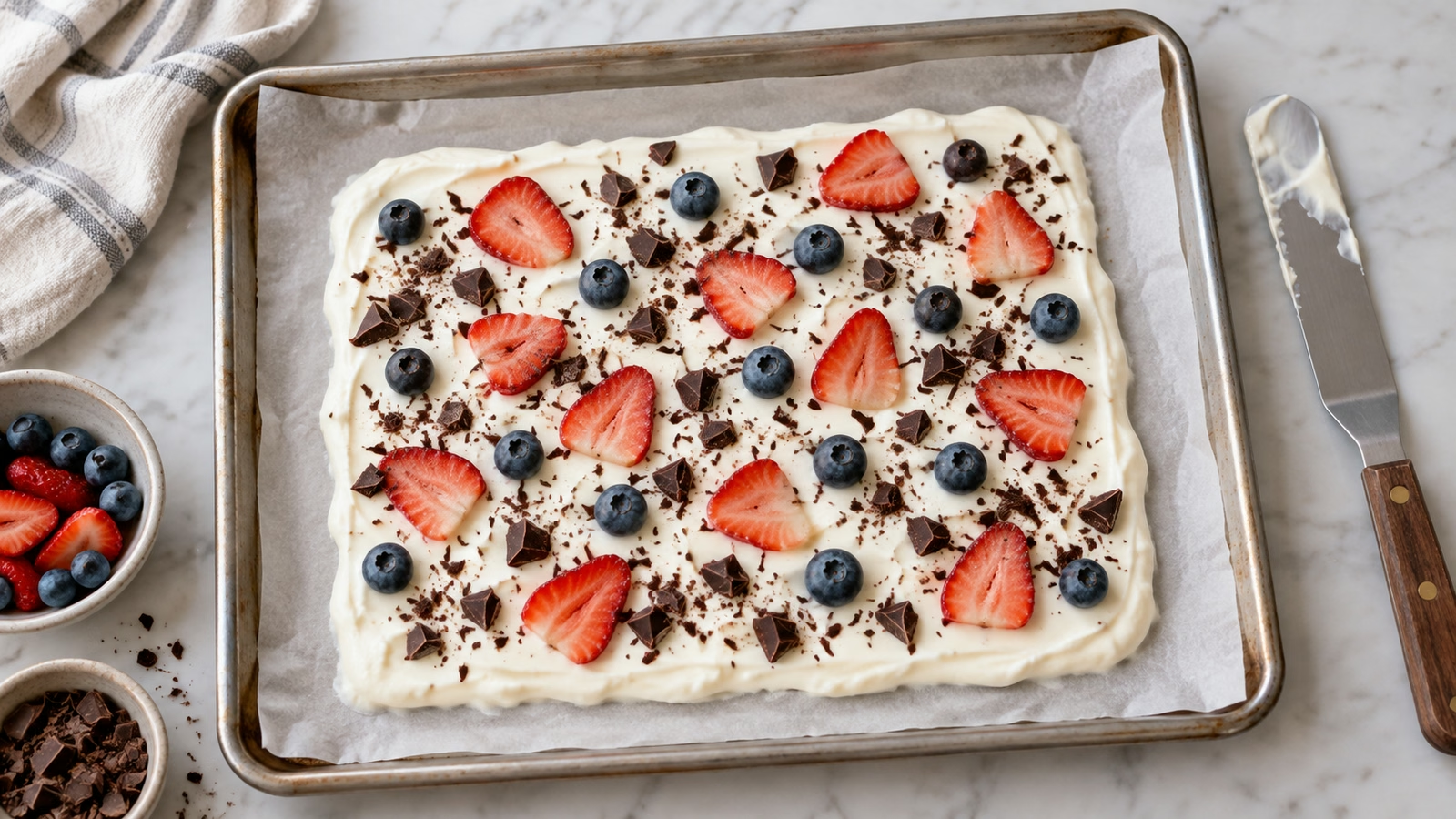
Line a tray that fits flat in your freezer, leaving enough parchment to lift the frozen sheet. Spread the mixture to roughly 10 by 12 inches (25 by 30 cm), aiming for about a quarter inch (6 mm) thick. The dimensions are a guide; even thickness matters more than drawing a perfect rectangle.
If your freezer only holds a smaller tray, divide the mixture between two containers rather than making one deep block. Keep the topping distribution fairly even, then move the tray carefully so the wet yogurt does not slide into a thick corner.
- Before mixing: check freezer space and make sure the tray rests level without balancing on soft packages.
- Before freezing: gently press the berries and chocolate into the surface. Loose toppings fall away when the sheet breaks.
- After three hours: lift an edge with the parchment. The middle should be solid, not bend like a soft blanket.
- If still soft: return it to the freezer. Thickness, the yogurt and your appliance affect the timing.
- When breaking: use clean hands and work quickly. Irregular pieces are fine; forcing tidy squares adds work without changing the snack.
Keep the bark frozen until you want a piece
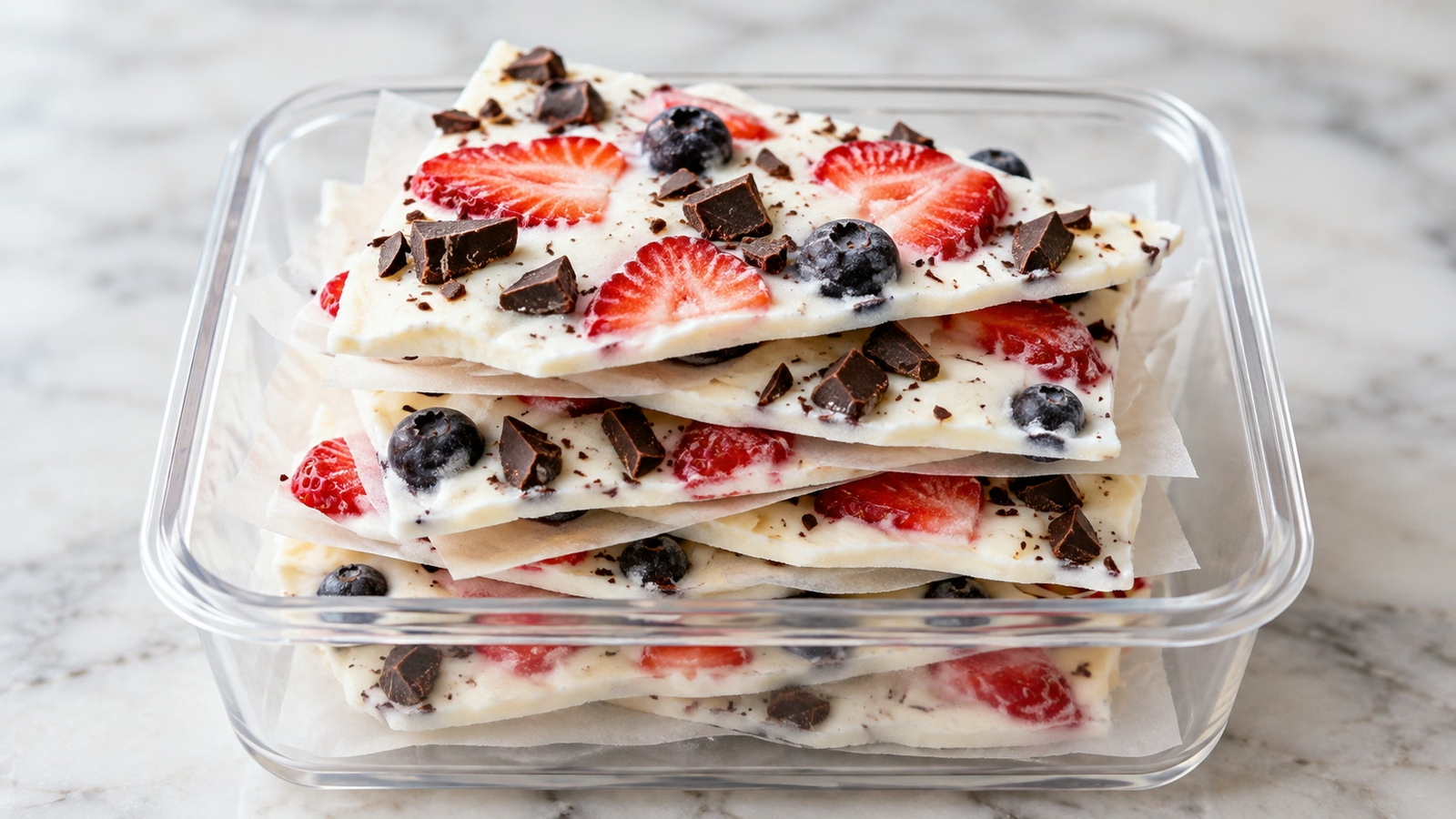
Once firm, break the sheet into pieces and divide it into eight portions. Put parchment between layers in a sealed freezer-safe container. That makes it easier to take out a little at a time instead of warming the whole batch while searching for a piece that will separate.
Serve directly from the freezer, allowing a brief moment to soften if it feels too hard to bite comfortably. Keep the rest frozen. The card estimate includes all yogurt, maple syrup, fruit and chocolate, divided into eight servings; it does not depend on making exactly eight identical shards.
- Temperature: keep the freezer at 0°F (−18°C), following FDA storage guidance.
- Quality: for this small batch, aim to finish it within two weeks. A tight container limits drying and freezer odors.
- Melting: bark will soften into yogurt at room temperature. Take out only what you plan to eat rather than serving a full platter.
- Allergens: the base contains milk; chocolate may contain soy or additional milk ingredients. Read labels for individual needs.
Frozen Yogurt Bark Recipe

Ingredients
- 500 g plain whole-milk Greek yogurt about 2 cups; thick, not drinkable
- 2 tablespoons pure maple syrup 40 g
- 1 teaspoon vanilla extract 4.2 g
- 2/3 cup sliced strawberries 100 g, washed, dried and thinly sliced
- 1/3 cup blueberries 60 g, washed and dried; halve very large berries
- 30 g semisweet chocolate about 3 tablespoons, finely chopped
Equipment
- 1 Baking tray that fits the freezer
- 1 Parchment paper
- 1 Mixing bowl
- 1 Spatula
- 1 Freezer-safe storage container
Instructions
- Clear a level freezer space. Line a suitable tray with parchment, leaving a little overhang for lifting.
- Stir the yogurt, maple syrup and vanilla together until uniform. Spread onto the parchment in a roughly 10-by-12-inch (25-by-30-cm) rectangle about 1/4 inch (6 mm) thick. Divide between two smaller trays if needed to maintain that thickness.
- Scatter the strawberries, blueberries and chocolate evenly across the surface. Press them lightly into the yogurt.
- Freeze flat at 0°F (−18°C) for at least 3 hours, or until the center is completely firm. A thicker layer may need longer.
- Lift with the parchment and break into irregular pieces. Divide into eight portions. Serve directly from the freezer, with a brief softening pause if too hard to bite. Store the rest promptly in a sealed freezer container with parchment between layers.
Nutrition
Notes
Tried this recipe?
Let us know how it turned out!Sources
- Parade: frozen yogurt bark technique and trend background
- Parade: July 2026 viral-recipe collection
- FDA: safe refrigerator and freezer storage
- USDA FoodData Central: SR Legacy ingredient data
Hi, I’m Laura, the voice behind Tastiva. I’ve always believed that eating well should feel enjoyable, comforting, and realistic—not like another complicated rule to follow. I love creating recipes that fit into everyday life, sharing simple nutrition ideas, and finding small ways to make meals feel a little better without losing the pleasure of good food.