
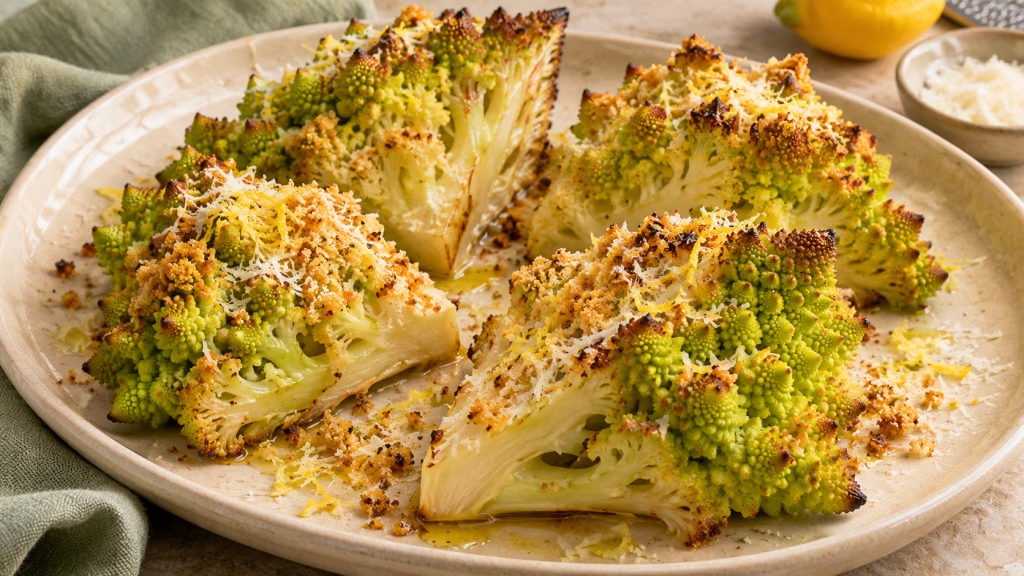
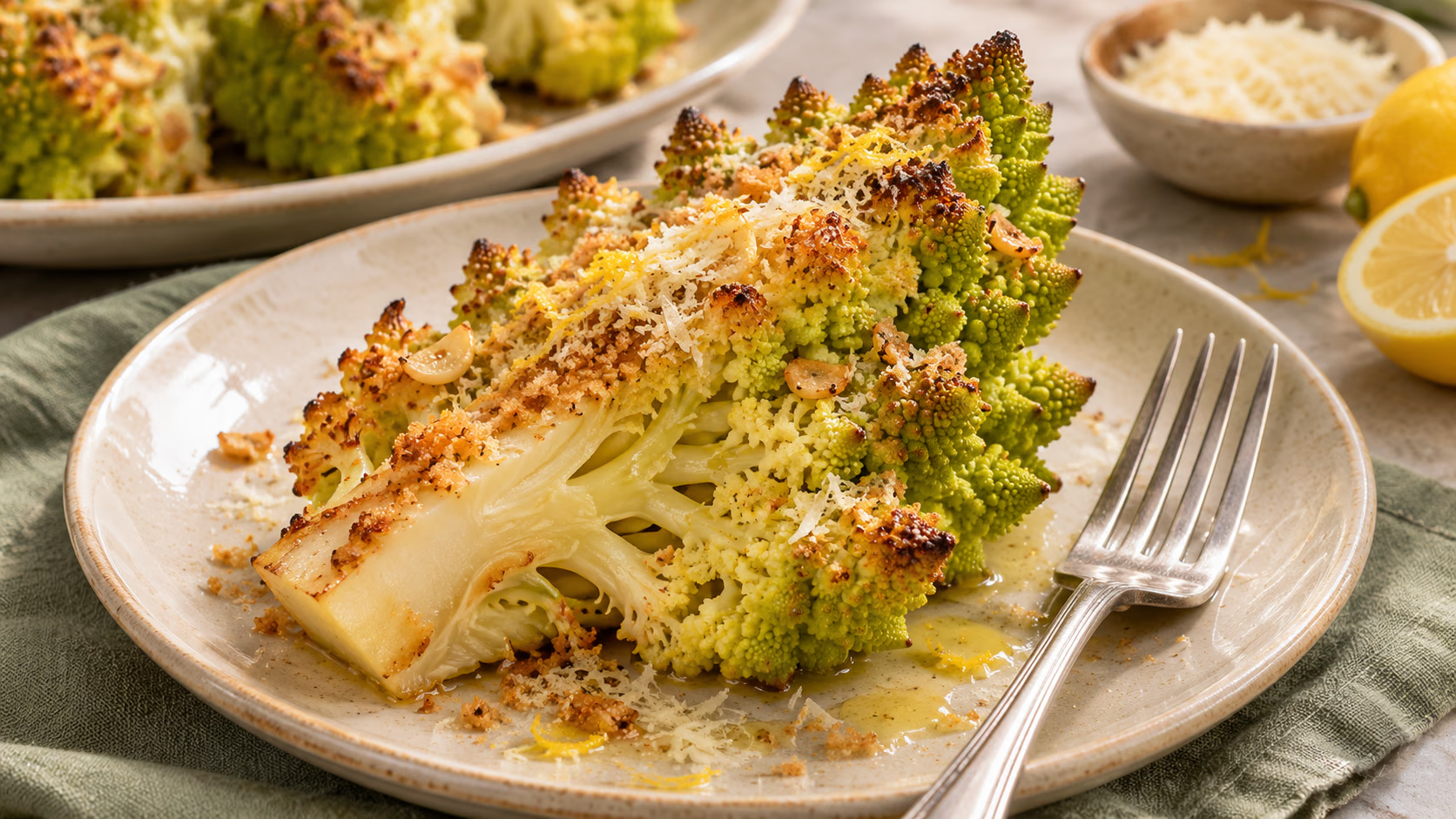
Roasted romanesco gives those pointed green spirals golden edges while the thicker center turns tender. This version keeps the head in wedges and finishes it with garlic, Parmesan crumbs and lemon. The useful trick is waiting to add the topping until the vegetable has already had time in the oven.
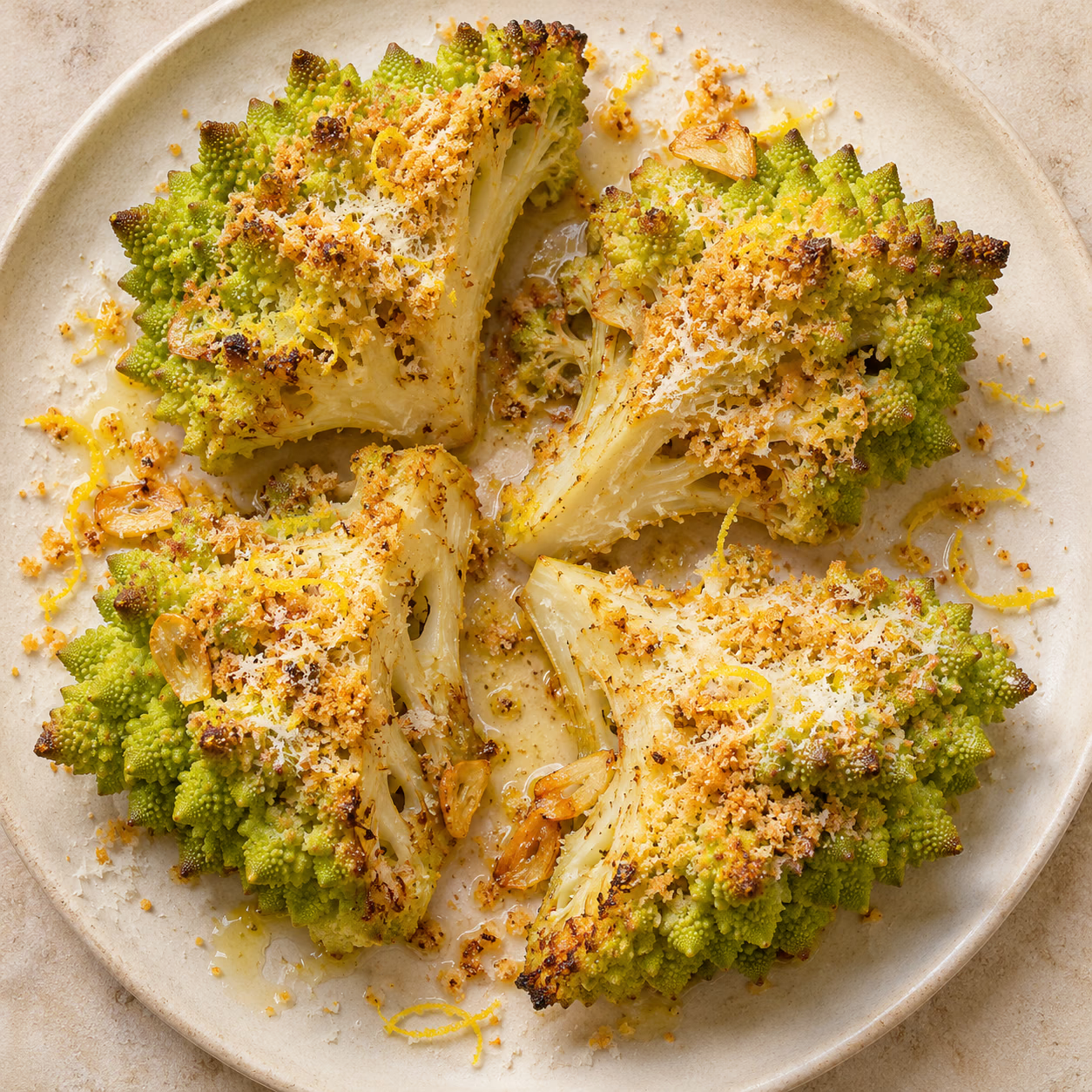
Keep a little core attached to each wedge, give the cut sides room on the pan, and judge doneness at the thickest center rather than by the browned tips alone.
Serving Suggestions
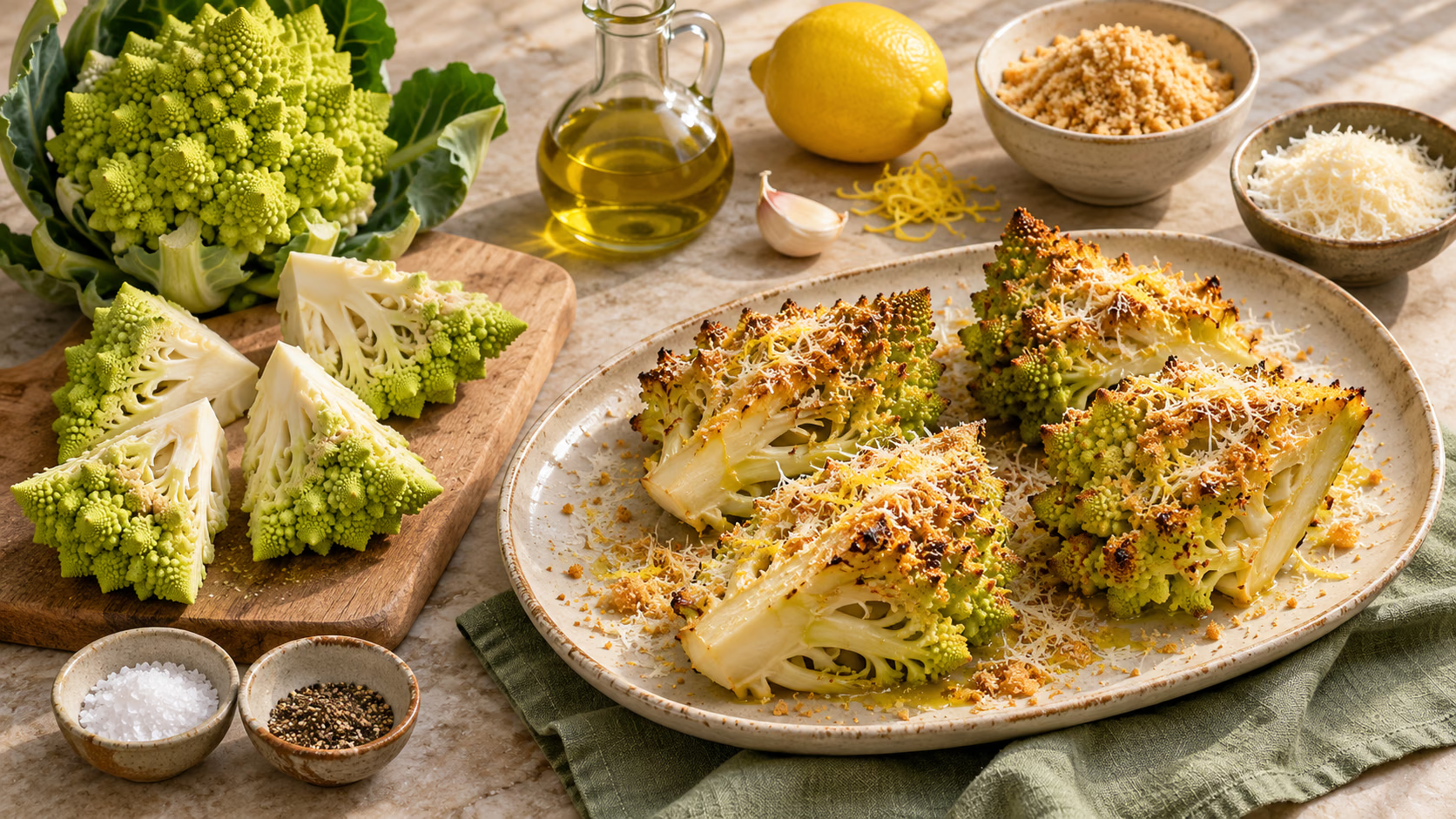
I like the contrast of a crisp breadcrumb topping with something soft on the plate. Spoon white beans beside the wedges, or serve them with a simple omelet and bread. For a larger dinner, add roast chicken or fish without loading another sauce over the crumbs.
A medium head makes four side portions. Offer one wedge per person while it is warm, when the tips and crumbs still have some crispness. The pale core is part of the serving, not a handle to discard; if it feels resistant to a knife, the pan needs more time.
A squeeze of lemon is enough to lift the cheese and oil. I would keep extra lemon at the table rather than soaking the whole platter ahead of time. That lets everyone adjust the acidity while keeping the topping from turning damp.
| On the plate | Why it works |
|---|---|
| White beans | Soft texture against crisp crumbs |
| Simple omelet | A mild partner for lemon and cheese |
| Roast chicken | A main dish beside the vegetable wedges |
Variations
The wedge shape makes this recipe distinctive, but size matters more than a fixed number of pieces. If your head is especially large, divide it into six narrower wedges and share those between four people. Similar thickness helps them finish together; a dense, oversized core can stay firm after the tips look ready.
- For a vegetarian version, check that the hard cheese uses vegetarian rennet; traditional Parmesan may not.
- For a gluten-free version, use plain gluten-free breadcrumbs and check the cheese label. Crumb size can change how quickly the topping browns.
- For a little heat, add a pinch of red pepper flakes to the breadcrumb mixture. Keep the lemon finish.
If romanesco is unavailable, cauliflower wedges are a practical substitute, though the flavor and appearance will differ. For another sturdy roasted vegetable, try our roasted kohlrabi. Keep the same knife test instead of assuming the cooking time will be identical. Broccoli florets are smaller and need a shorter roast, so I would not treat them as a straight timing swap.
Health Benefits
This is a vegetable side dish with oil, cheese and breadcrumbs, not a complete meal by itself. Pairing it with beans, eggs, fish or another protein source makes the plate more substantial. The topping brings flavor and texture without needing to cover every spiral in a thick coating.
The estimated serving provides about 4 grams of fiber and 6 grams of protein. The calculation uses raw cauliflower nutrition data as a proxy for romanesco, so treat the numbers as a guide rather than a precise analysis of this vegetable. The card explains the ingredient assumptions.
Cheese, breadcrumbs and added salt all contribute sodium. If that is something you track, compare your product labels and adjust the added salt to suit your needs. Changing brands or reducing the topping changes the estimate, too. There is no need to turn a pleasant vegetable dish into a promise of special health effects.
Bottom Line
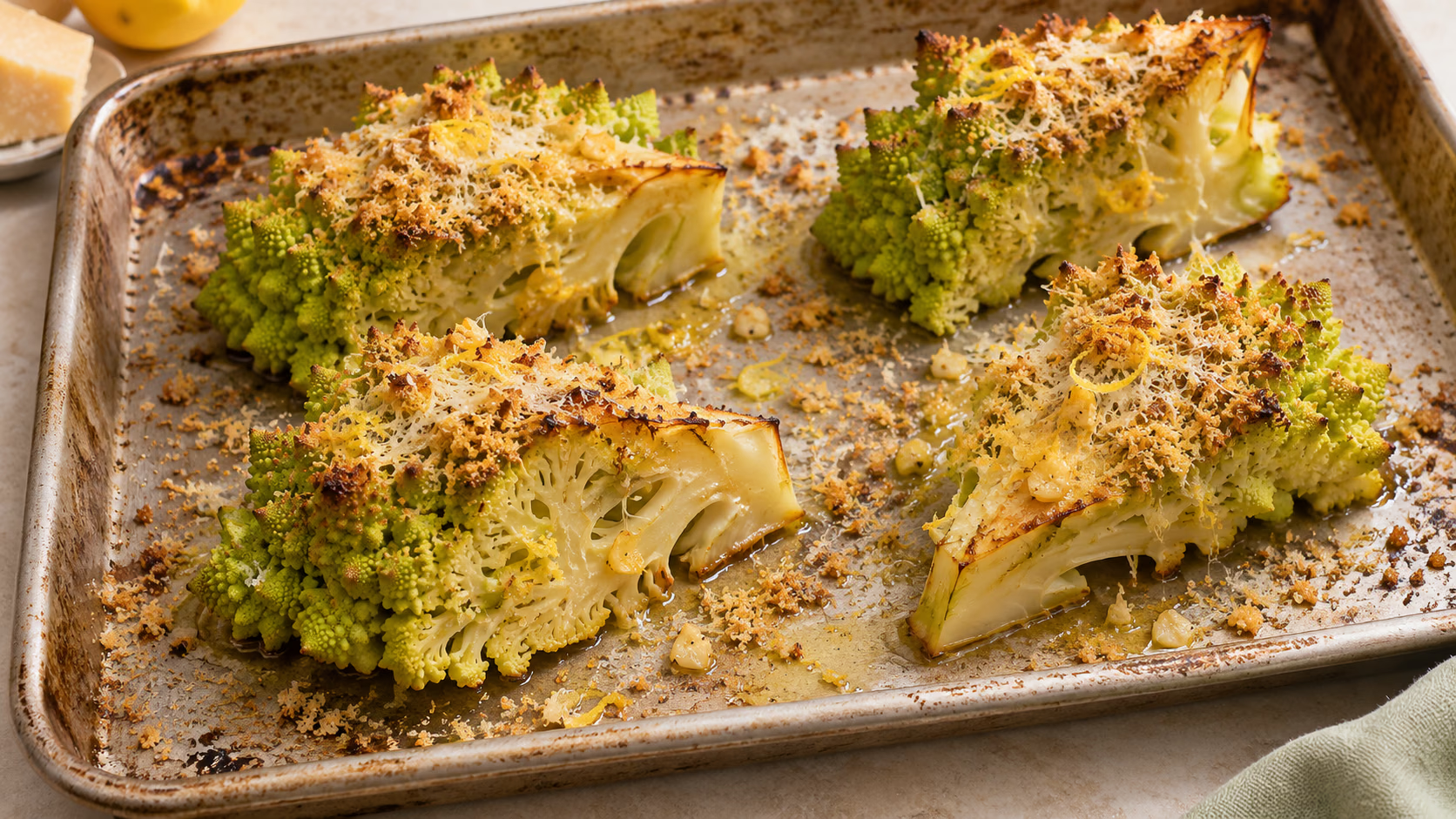
The most useful checkpoint is the core: it should give easily when pierced, while the crumb topping stays golden rather than dark brown. Adding the crumbs later gives you better control over those two different jobs. If they color too fast, cover loosely with foil while the center finishes.
Choose a firm head, dry it well and leave space between the wedges. Those small decisions matter more than an elaborate seasoning blend. My preference is to finish with zest and juice after roasting, so the lemon tastes fresh against the warm, savory crumbs.
The recipe below includes the full quantities, timing and a related Food Wishes demonstration. That video uses a different Roman-style seasoning, including anchovies; this version keeps a simpler lemon-and-cheese finish. Follow the written ingredient list and doneness cues for this dish.
Roasted Romanesco Recipe

Ingredients
- 1 medium head romanesco about 600 g after trimming
- 2 tablespoons olive oil divided
- 3 tablespoons plain dry breadcrumbs about 20 g
- 1/4 cup finely grated Parmesan 20 g; use vegetarian-rennet hard cheese if needed
- 1 clove garlic 3 g, thinly sliced
- 1 teaspoon lemon zest
- 1 tablespoon lemon juice
- 1/4 teaspoon fine salt
- 1/8 teaspoon black pepper
Equipment
- Rimmed sheet pan
- Cutting board and chef’s knife
- small mixing bowl
- fine grater or zester
- Spatula
Instructions
- Remove the romanesco leaves and trim the dry stem end. Cut the head into four wedges through the core, leaving enough core to hold each wedge together. Rinse and dry thoroughly.
- Heat the oven to 425°F (220°C). Rub the wedges with 1 tablespoon olive oil, salt and pepper. Set them on a rimmed sheet pan with a cut side down and space between the pieces. Roast for 20 minutes.
- Mix the breadcrumbs, Parmesan, sliced garlic and remaining 1 tablespoon olive oil in a bowl. Turn the wedges onto their other cut side. Spoon the crumb mixture over the upper surfaces and roast 8–12 minutes more, until the crumbs are golden and a small knife slips easily into the thickest core. If the crumbs darken before the core softens, loosely cover with foil and cook a little longer.
- Scatter over the lemon zest and drizzle with the lemon juice just before serving. Lift carefully with a spatula and divide into four side-dish portions.
Nutrition
Video
Notes
Tried this recipe?
Let us know how it turned out!Sources
Food Wishes: Roasted Roman-Style Romanesco (September 15, 2020), for the wedge-roasting demonstration; Food Literacy Center’s roasted romanesco, for adding breadcrumbs later; and University Hospitals’ breadcrumb and Parmesan nutrition tables.
Hi, I’m Laura, the voice behind Tastiva. I’ve always believed that eating well should feel enjoyable, comforting, and realistic—not like another complicated rule to follow. I love creating recipes that fit into everyday life, sharing simple nutrition ideas, and finding small ways to make meals feel a little better without losing the pleasure of good food.