
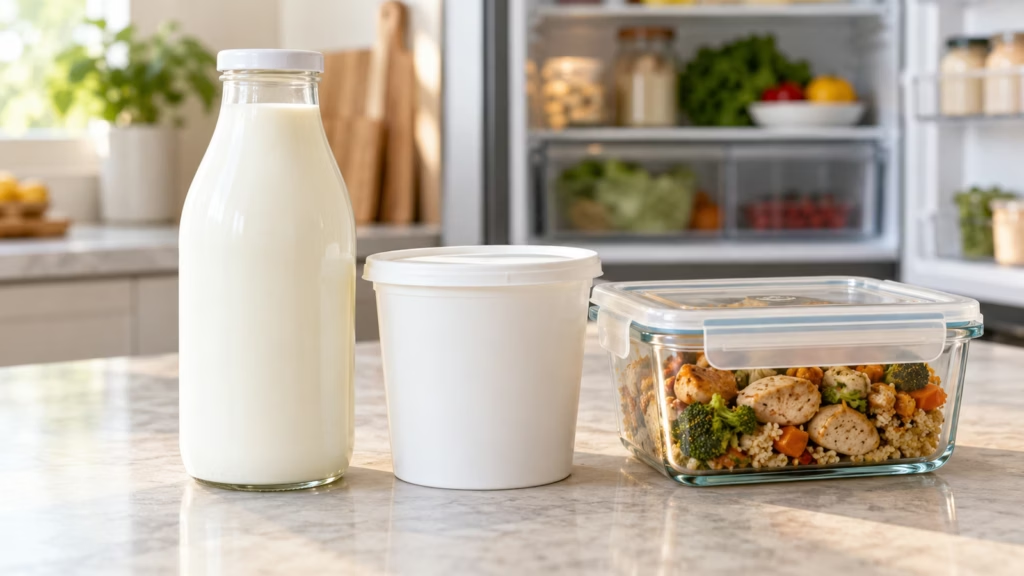
The carton is still sealed, the date was yesterday, and dinner suddenly comes with a label-reading puzzle. For best by vs use by vs sell by, start with the words, then check the food, its storage history, and the rules where you bought it. A quality date, a safety date, and a store’s stock-rotation date answer different questions; opening the package can add another clock.
Read the words beside the date, then match them to how the food has actually been stored.
Best by vs use by vs sell by: what each tells you
A “best” date generally describes expected quality, such as flavor or texture. “Sell by” guides store inventory, according to USDA’s food-product dating guidance; it is not your household storage deadline. “Use by” needs more context: older general US guidance may describe quality, while California now assigns that wording a safety meaning for covered products.
| Label | What it communicates | Your next check |
|---|---|---|
| Best by / Best if Used by | Expected quality | Condition, package directions, and storage history |
| Sell by | Retail stock rotation | Food-specific home storage guidance |
| Use by | Meaning depends on product and applicable rules | Treat an identified safety date as a limit; check manufacturer guidance |
| Use within X days of opening | A separate instruction after opening | Record the opening date and follow the stated interval |
I’d resist turning this table into a universal number of extra days. Crackers, refrigerated deli meat, and infant formula do not share one storage rule. A printed quality date can help you plan the pantry, but it cannot tell you what happened during a warm trip home or after someone opened the seal.
California’s 2026 rule changes the wording
California’s enacted AB 660 applies to covered food manufactured on or after July 1, 2026, and sold in California when a quality or safety date is displayed. It standardizes the wording and restricts consumer-readable sell-by labels. It does not create a nationwide rule, and it does not generally require an undated food to gain a date.
- Quality: “BEST if Used by” or “BEST if Used or Frozen by.” A passed quality date alone does not prohibit use under this law.
- Safety: “USE by” or “USE by or Freeze by.” Do not treat this identified safety date as a suggestion about crispness or flavor.
- Exclusions: Infant formula, eggs and pasteurized in-shell eggs, and beer and other malt beverages are excluded from this section; other provisions and exceptions can also apply.
- Older stock and other states: A package can still reflect different rules. Ask the manufacturer when the wording or instructions are unclear.
The CDFA consumer explanation distinguishes quality from safety dates. Infant formula deserves separate attention regardless of the California exclusion: FDA guidance says to use it by its labeled use-by date. An exemption from one state labeling section is not permission to ignore the product’s directions.
Opening and refrigeration have their own clocks
An unopened package’s date does not cancel its after-opening instructions. FoodSafety.gov’s cold-storage chart shows why the distinction matters: refrigerated luncheon meat has different windows when sealed and when opened. Look up the exact food and form, rather than borrowing a rule from a similar-looking package. Tastiva’s brown-rice guide covers cooling and storing cooked rice, a useful example of food-specific directions.
- Opening: Write the date on the container. If the label specifies an interval after opening, count from that event while still respecting applicable safety dates.
- Cooling: Keep the refrigerator at 40°F (4°C) or below and the freezer at 0°F (-18°C). Check with an appliance thermometer.
- Time outside refrigeration: FDA limits perishables at room temperature to two hours, or one hour above 90°F (32°C). A future printed date does not repair mishandling.
- Preparation: Cooking, mixing, or repacking creates a new practical storage question. Keep the original instructions if they will be useful later.
For a hypothetical jar opened on Monday with a “use within five days” instruction, the useful note is “opened Monday,” not just the month printed on the lid. If you cannot remember the opening date or storage conditions, the package date cannot supply that missing information.
Make the decision before dinner depends on it
I’d use date labels to organize meals before they become a last-minute judgment call. Put items needing attention where you can see them and plan a use for them while their handling and timing are still clear. This is especially useful for a container that gets pushed behind newer groceries.
- Identify the date. Read the whole phrase and nearby instructions, including refrigeration and opening directions.
- Check the history. Was the food continuously stored as directed? Is the package intact? Has an applicable safety date or opening limit passed?
- Use the right reference. Check the product label, manufacturer, or FoodSafety.gov for that food. Do not add an arbitrary grace period.
- Plan earlier next time. Buy a manageable amount, note opening dates, and freeze suitable food while it is still safely handled and within its instructions.
Discard suspicious or spoiled food, but do not use a normal smell or appearance as proof of safety: FDA explains that harmful bacteria can be present without obvious spoilage. Do not taste a questionable food to decide. Freezing is a planning tool, not a way to reverse unsafe storage; if the history is uncertain, choose a different ingredient for dinner.
This June 2026 report from CBS 8 San Diego explains the California label changes discussed above. It covers the state’s July 1 change, rather than a nationwide rule; keep the product-specific safety dates and storage instructions in the decision.
Sources
- California Department of Food and Agriculture: Food Date Labeling
- California AB 660: enacted food-date labeling rules
- FDA: Tips to Reduce Food Waste
- FDA: Are You Storing Food Safely?
- FoodSafety.gov: Cold Food Storage Chart
- USDA FSIS: Food Product Dating

Hi, I’m Laura, the voice behind Tastiva. I’ve always believed that eating well should feel enjoyable, comforting, and realistic—not like another complicated rule to follow. I love creating recipes that fit into everyday life, sharing simple nutrition ideas, and finding small ways to make meals feel a little better without losing the pleasure of good food.