
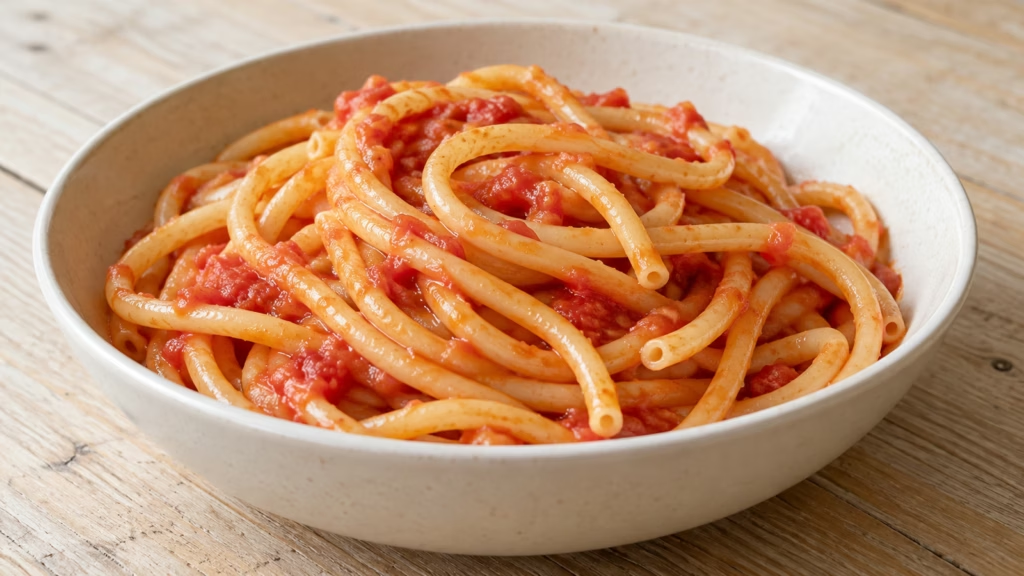
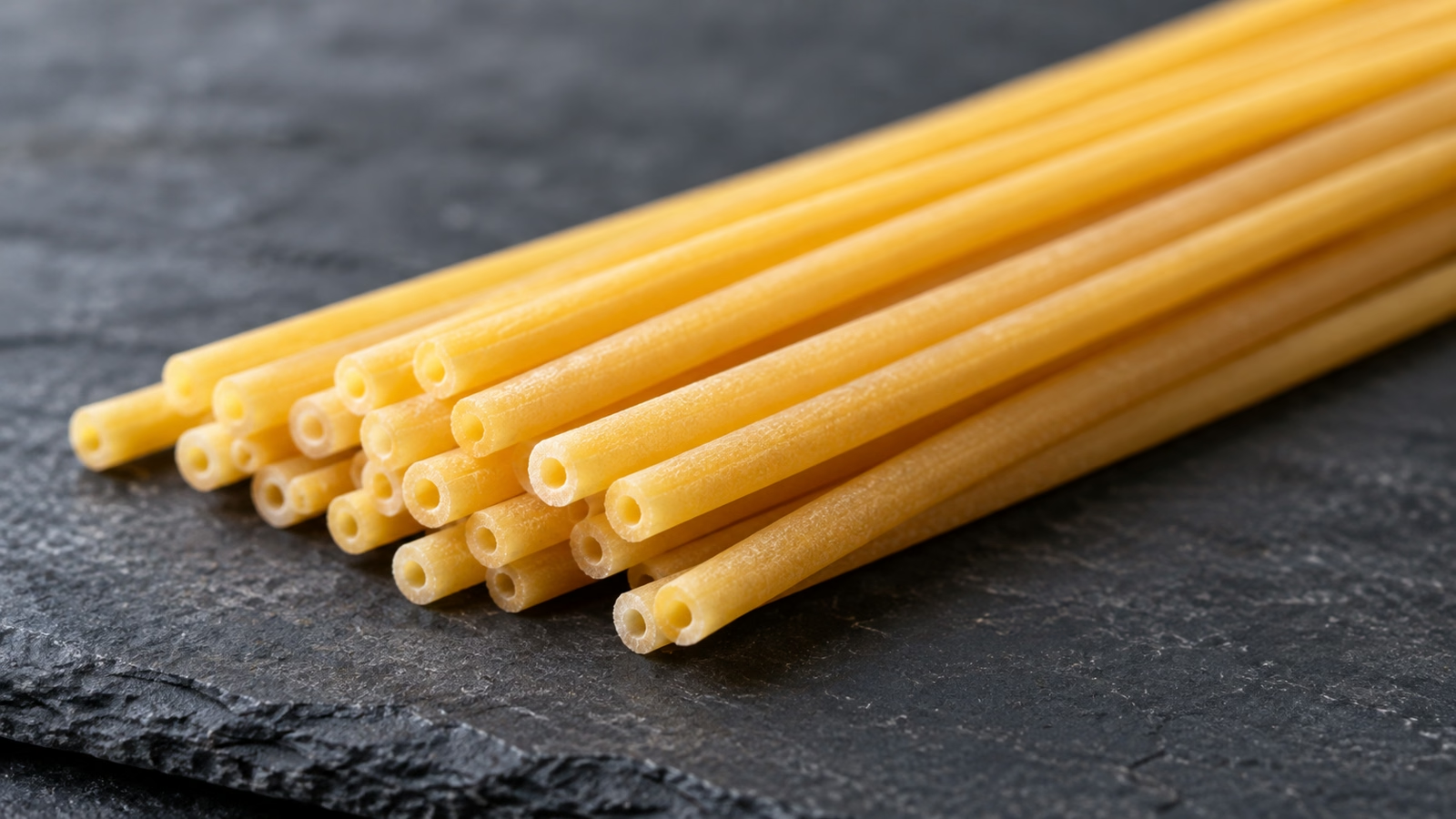
At first glance, the bundle looks like thick spaghetti. Look at the cut ends and the difference appears: bucatini pasta has a narrow hole running through each long, rounded strand. That hollow shape gives it a more substantial bite than a delicate noodle and makes it a natural partner for sauces with some presence, especially tomato-based combinations.
Treat bucatini as a long hollow pasta: give it room to move, a sauce that coats, and a taste check before serving.
I’d choose it for a dinner where the pasta itself should be noticeable. You do not have to make a complicated sauce to justify the box, and you do not have to turn dinner into a lesson in pasta geography.
What makes bucatini pasta different
Bucatini is round in cross section, like spaghetti, but hollow. De Cecco also uses the name perciatelli for this shape. The Italian word buco means hole; here it is a useful description of the ingredient rather than a hidden cooking trick.
- Compared with spaghetti: Both are long strands, but spaghetti is solid. A swap changes the bite even if the same sauce works with both.
- Compared with linguine: Linguine is a narrow, flat strand. Bucatini has a round, tubular profile, so do not expect the same way of folding and twirling.
- Compared with short tubes: Penne and rigatoni are designed for shorter forkfuls. Bucatini keeps the long-strand experience, with a small channel inside.
- On the ingredient label: Classic dried versions use durum wheat. The shape does not establish whole-grain or gluten-free status.
The hollow center is a good identifying feature, but I would not build a meal around a promise that every strand will fill completely with sauce. The practical task is still to cook the pasta properly and coat its outside well. For the grain terminology, Tastiva’s durum wheat pasta guide explains what semolina means.
Cook for a firm bite, then finish with the sauce
Follow the directions for the actual box in your hand. De Cecco’s Bucatini No. 15 lists 9 minutes for al dente and 11 minutes for its standard cooking time; Barilla’s Al Bronzo bucatini lists 9–11 minutes. Those examples show why one universal minute count would be less useful than your package and a taste.
- Get the sauce ready first. Have the pan and any finishing ingredients prepared so the drained pasta can move straight into the next step.
- Use boiling water and stir. Let the strands soften into the pot without forcing them. Follow the package directions and stir to separate the pasta.
- Check a strand near the recommended endpoint. Let it cool enough to taste safely. The pasta should be tender with pleasant resistance, rather than rigid or chalky.
- Reserve cooking water. Keep some before draining, then add small amounts if the sauce needs loosening. You can add more; removing excess liquid is less convenient.
- Finish as the recipe directs. A sauce that needs a final simmer and a delicate cheese sauce do not have identical heat requirements. Follow the full dish’s method instead of applying one high-heat finish to everything.
For hot sauced pasta, Barilla recommends skipping oil in the boiling water and not rinsing after draining. Keep the useful starch, then mix with the sauce while the pasta is still ready to take its place at the table.
Sauce directions that suit the shape
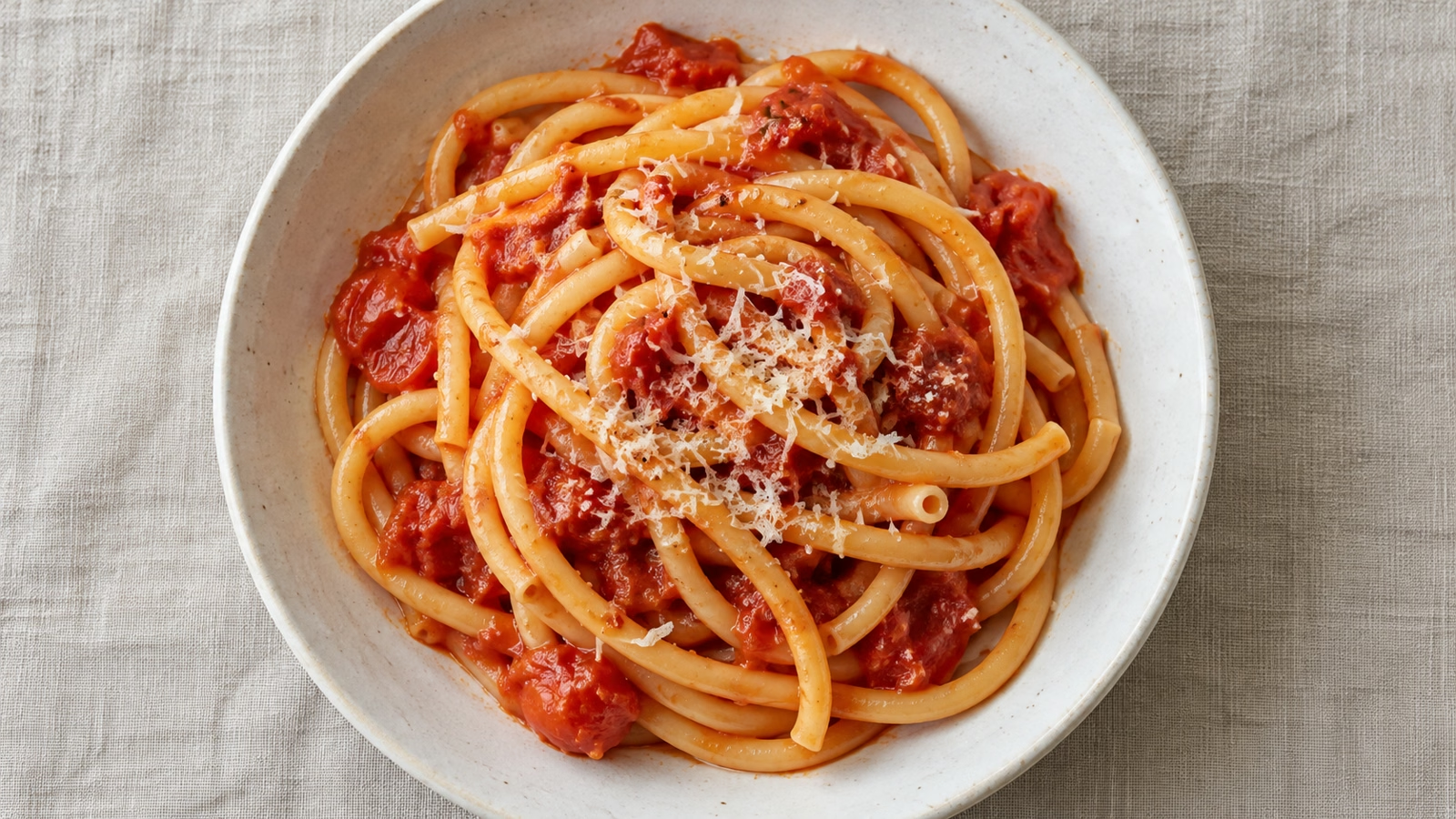
Bucatini can carry several kinds of sauce; amatriciana is a familiar pairing, not its only purpose. De Cecco describes that combination with tomato, pork cheek, and pecorino romano. A simple tomato-coated bowl is also a perfectly sensible way to get acquainted with the shape.
- Tomato and pecorino: Let the sauce coat the strands and add cheese thoughtfully. Tastiva’s pecorino guide explains the sheep’s-milk cheese family and its uses.
- Tomato with vegetables: Peppers, eggplant, zucchini, olives, or capers are among the combinations suggested by De Cecco. Keep the pieces manageable alongside long pasta.
- Creamy mushrooms: Choose a complete recipe that develops the mushrooms and balances the sauce before tossing. A heavy pile of cream is not required just because the pasta is thick.
- Butter or cheese-based sauce: Follow the recipe’s temperature and mixing steps closely. Additions such as black pepper can keep the flavor direction clear without an overfull ingredient list.
I’d start with tomato for the first bowl because it makes the shape easy to see and the coating easy to judge. Once you know whether you enjoy that substantial strand, move toward the richer or more strongly flavored combinations that appeal to you.
Useful swaps and small problems to avoid
A substitution is mostly a decision about texture here. Another long pasta can carry many of the same sauces, but it will not recreate the hollow strand. Match the replacement to the sauce and cook it by its own instructions.
- Only spaghetti available? Use it for a compatible long-pasta dish and expect a different bite. Do not keep the bucatini cooking time automatically.
- Sauce sitting beneath the pasta? Mix the two together before plating, adjusting consistency gradually. Pouring a thick spoonful over a dry mound rarely gives an even coating.
- Strands difficult to manage? Serve modest forkfuls and give yourself room in the bowl. Bucatini does not need to be eaten with competitive twirling.
- A recipe calls for a specialty version? Check its ingredients and dimensions. Long, extra-long, and alternative-flour products can call for different handling.
Vincenzo’s Plate demonstrates bucatini amatriciana in the video below, including cooking the pasta and combining it with sauce. It is one particular dish, offered as a visual example alongside this ingredient guide.
Sources
- De Cecco: Bucatini No. 15
- Barilla: Al Bronzo bucatini and cooking guidance
- Barilla: Pasta cooking technique
- Barilla: Bucatini with creamy mushrooms
- Giadzy: Bucatini’s name and hollow shape

Hi, I’m Laura, the voice behind Tastiva. I’ve always believed that eating well should feel enjoyable, comforting, and realistic—not like another complicated rule to follow. I love creating recipes that fit into everyday life, sharing simple nutrition ideas, and finding small ways to make meals feel a little better without losing the pleasure of good food.