
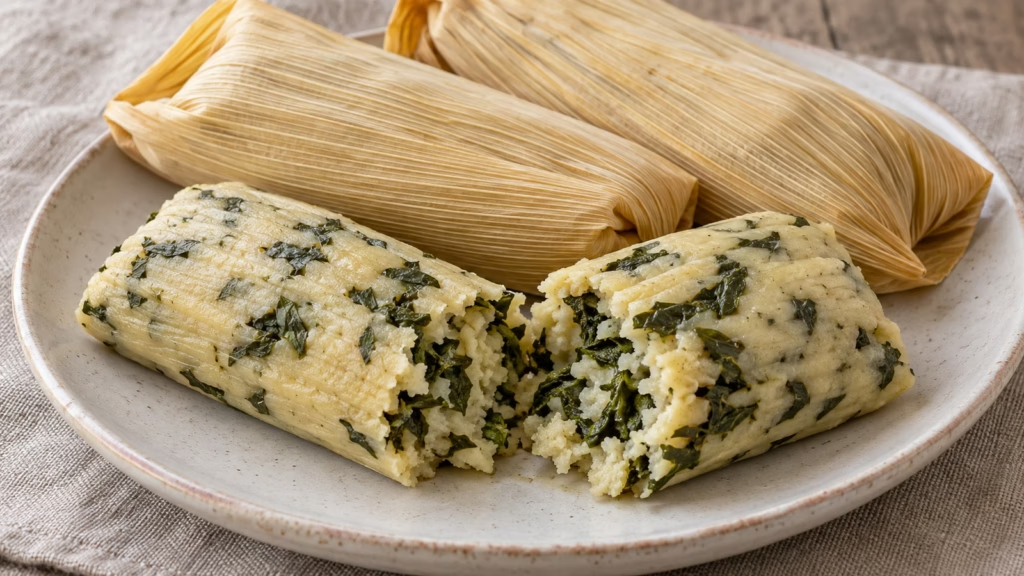
A spoonful of masa flecked with small green leaves tells you what matters in chipilín tamales: the greens belong throughout the dough. This corn-husk version folds fresh chipilín into soft masa with lard, then steams the parcels until they release cleanly from their wrappers. There is no separate filling to hide in the middle.
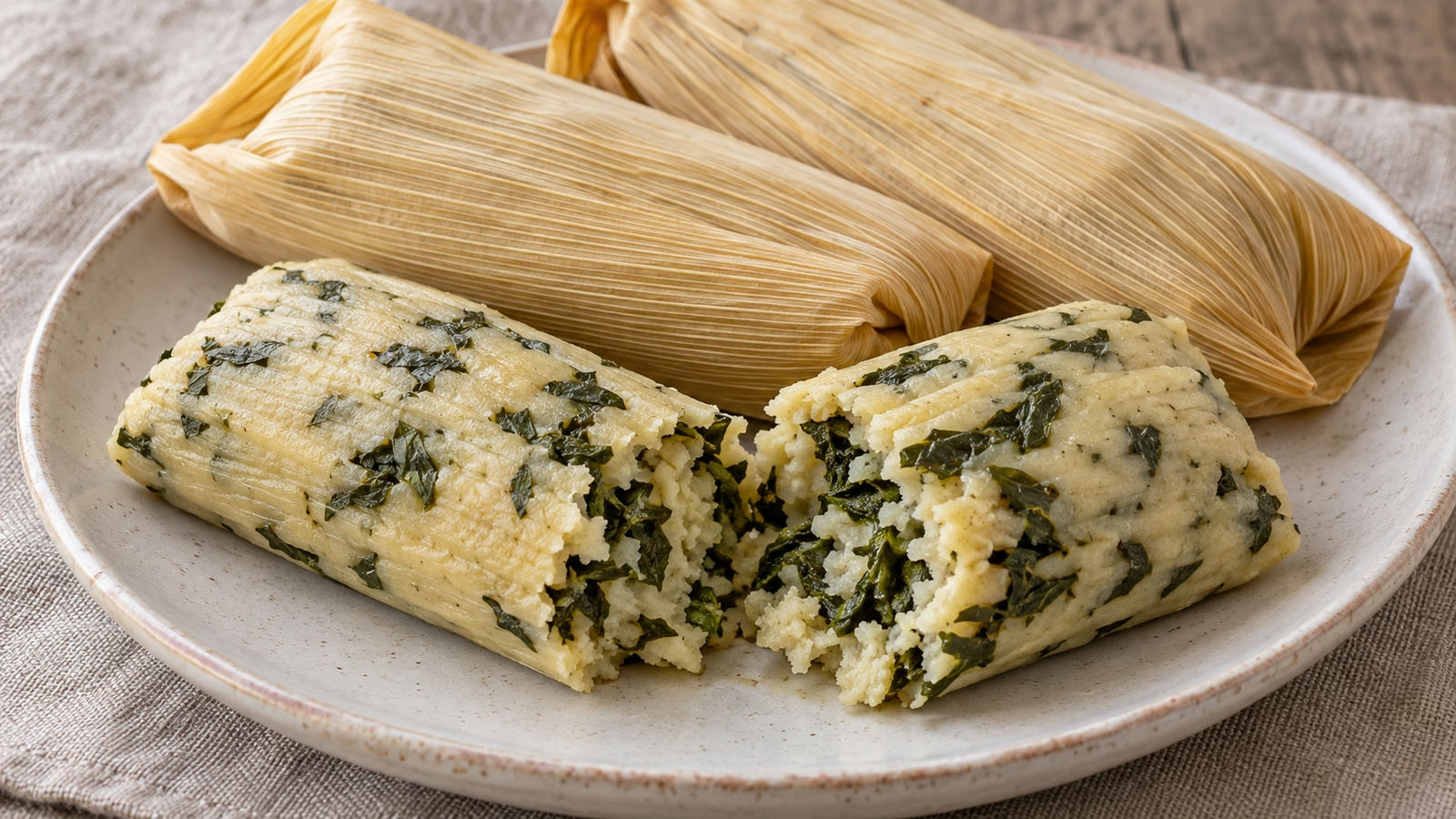
Spread the leaves through the whole bowl before you wrap. Every tamal should carry the same balance of corn and greens.
Chipilín tamales and their regional variations
Tamales de chipilín are part of southeastern Mexican cooking, with variations in broth, masa preparation and wrapping. Larousse’s Mexican culinary dictionary describes versions from Tabasco, Quintana Roo and Chiapas, often wrapped in banana leaf and sometimes in corn husks. Those differences are worth keeping rather than treating every green-flecked tamal as identical.
The formula here uses fresh, plain nixtamalized masa, food-grade chipilín leaves, water and lard, wrapped in dried corn husks. I would serve a little tomato salsa alongside, where it can brighten the plate without covering the first taste of the corn and leaves. Lard is part of this version, so it is not vegetarian.
- Buy chipilín sold for cooking from a reliable market or grower. Do not identify or gather unfamiliar plants by visual resemblance.
- Use fresh leaves for the listed quantity. Dried chipilín would need a different amount and moisture adjustment.
- Remove tough stems, wash the greens and drain them well before weighing the cleaned leaves.
Build a dough that spreads without running
The recipe uses 2.2 pounds of fresh masa and 2.8 ounces of prepared chipilín, with gram weights in the card for precision. Fresh masa already contains water. Dry masa harina cannot replace it ounce for ounce; our corn flour and masa harina guide explains the shopping distinction.
- Start with plain masa that has no added salt or fat. Prepared tamal dough would duplicate some of the ingredients.
- Beat the softened lard until lighter before adding the masa in pieces. A melted pool of fat is harder to work into an evenly soft dough.
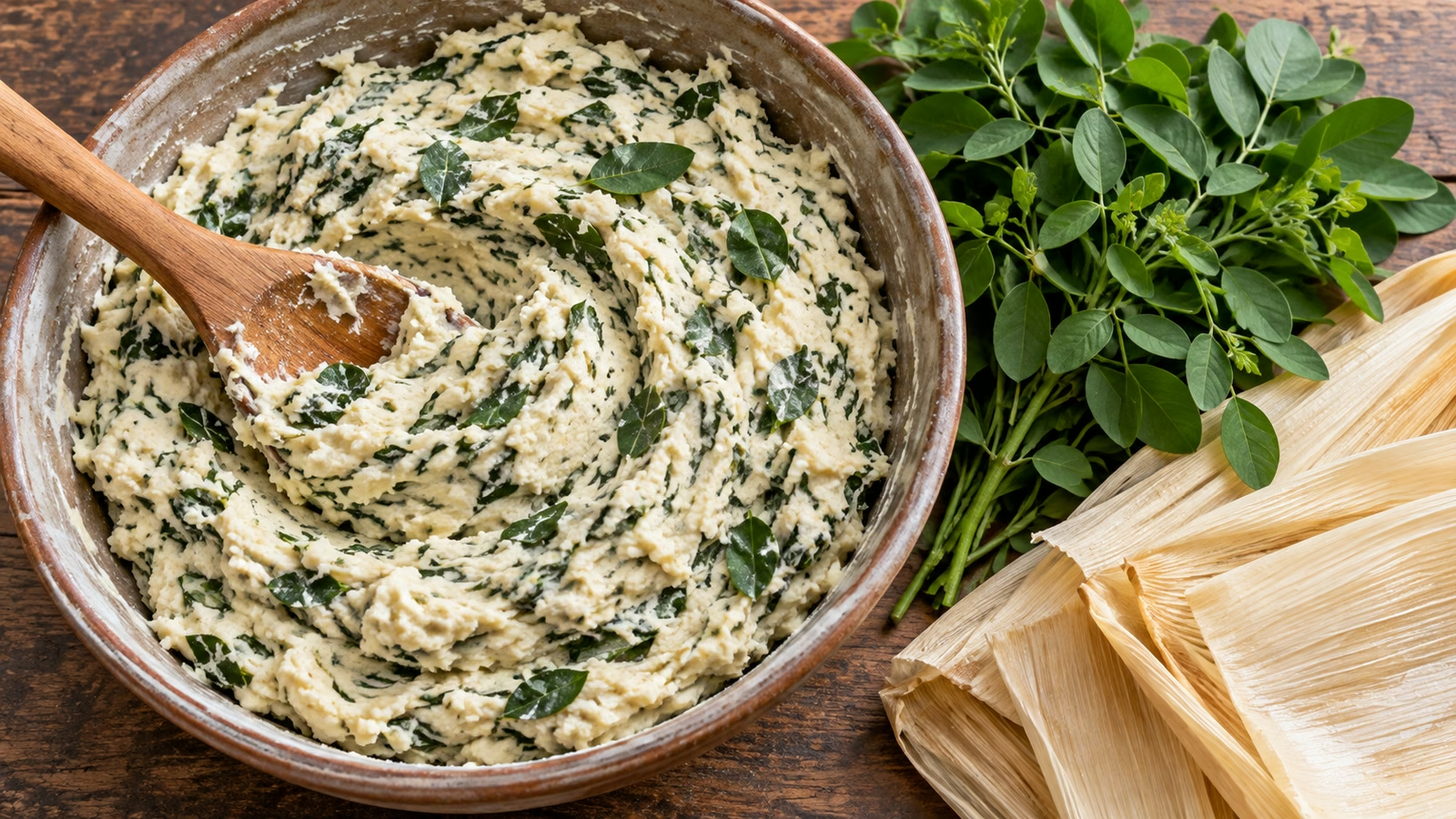
- Add the measured warm water gradually. Stop when a spoonful spreads comfortably on a husk and stays in place.
- Fold in the drained leaves with a spatula, checking the bottom of the bowl so they do not gather in one pocket.
I would judge the mixture by how it behaves on the wrapper rather than chase a fixed amount of extra liquid. If it cracks and resists spreading, add a tablespoon of water and mix again. If it already slides around the husk, more water is not the answer. Softness and looseness are different things here.
A simple fold and a patient doneness check
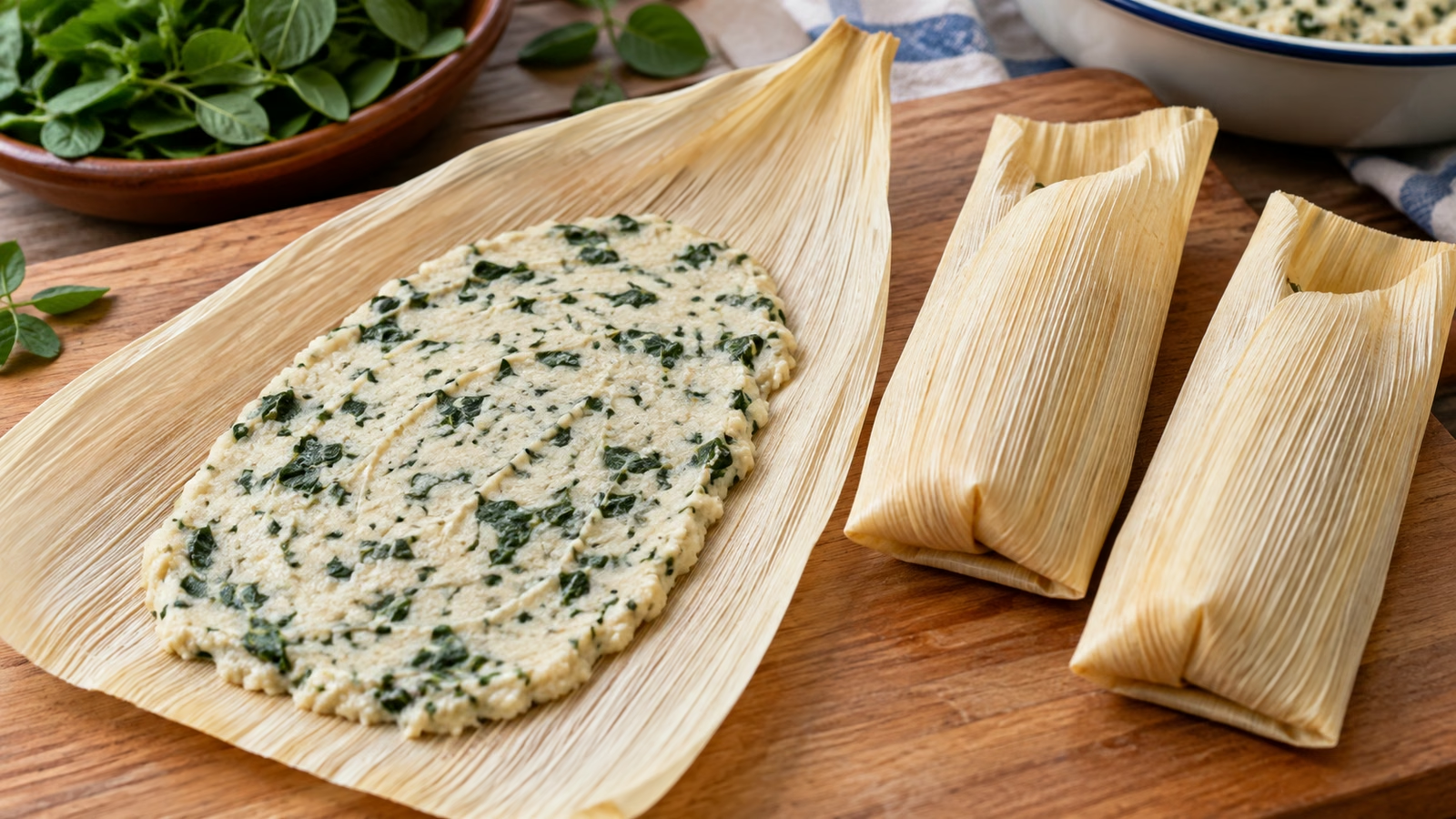
Soak the corn husks until they bend easily, then drain them. Set aside the broadest sixteen and keep extras for patching tears and covering the steamer. Divide the dough evenly before wrapping; a consistent portion makes cooking more predictable and keeps the leaves from disappearing into oversized parcels.
- Spread the dough across the broad part of each husk, leaving a margin along the sides and a bare narrow end.
- Fold the long sides over the masa, then lift the narrow end upward. Keep the top open and face it upward in the pot.
- Set the tamales on a rack above the water. Leave room between them so steam can travel through the batch.
- Cover with spare husks and a lid. Steam for 60–75 minutes from the point when the pot produces steady steam, adding hot water carefully if needed.
- Rest one test tamal for five minutes before peeling back the husk. Look for a cooked center and easy release; continue in ten-minute intervals if the dough is still raw.
After cooking, let the full batch rest twenty minutes. Opening every parcel immediately can make a tender tamal seem unfinished simply because it is still fragile. Steam deserves caution, too: lift the lid away from your face and use tongs when moving a test piece.
Serving, storage and what the estimate includes
Keep the meal simple enough to notice the chipilín. Salsa, beans or a chosen main dish can sit beside the tamales, with their quantities counted separately. The nutrition shown in the card covers one of sixteen tamales and includes all the measured lard; it excludes wrappers and accompaniments.
- Peel away the corn husk before eating. The wrapper supports cooking and serving, not the edible portion.
- Refrigerate leftovers promptly in shallow containers, within two hours or one hour above 90°F. Maintain 40°F or below.
- Use refrigerated tamales within three to four days and reheat their centers to 165°F.
- The estimate combines matching fresh-masa, chipilín and other ingredient records. Some nutrients remain unavailable in those sources; an omitted field does not mean zero.
Chipilín Tamales Recipe

Ingredients
- 2.2 lb fresh white nixtamalized masa 1,000 g, plain, with no added salt or fat
- 8.8 oz lard 250 g, softened
- 2.8 oz fresh chipilín leaves 80 g after removing tough stems, washing and draining
- 3/4 cup plus 1 tbsp warm water 200 ml, added gradually
- 1 1/2 tsp double-acting baking powder 6 g
- 1 1/3 tsp fine salt 8 g
- 16 large dried corn husks plus extras for covering the pot
Equipment
- Steamer with rack and lid
- large mixing bowl
- Hand mixer or stand mixer
- Kitchen scale
- Instant-read thermometer
Instructions
- Soak the corn husks in hot water for 20–30 minutes, until flexible; drain. Wash food-grade chipilín, remove tough stems and weigh 80 g of drained leaves.
- Beat the softened lard for about 5 minutes until lighter. Add the masa in pieces, the baking powder and salt. Beat in the water gradually until the dough spreads easily but does not run off the husk. Fold in the chipilín evenly.
- Divide into sixteen portions. Spread each portion on the broad part of a husk with a margin along the sides. Fold both long sides over the dough, then fold the narrow bottom upward, leaving the top open.
- Stand the tamales open-end up on a rack above the steamer water. Leave space for steam. Cover with spare husks and the lid.
- Once steady steam rises, cook for 60–75 minutes. Check the water level and add hot water carefully at the side as needed. Rest one test tamal for 5 minutes; it should release from its husk and have a cooked center. Continue in 10-minute intervals if necessary.
- Rest the finished batch for 20 minutes. Remove the husks before eating and offer salsa separately if desired.
Nutrition
Notes
Tried this recipe?
Let us know how it turned out!Sources
- Larousse Cocina: tamal de chipilín.
- INCAP food composition tables, INCMNSZ tables and USDA SR Legacy.
- USDA FSIS: safe leftovers.
Hi, I’m Laura, the voice behind Tastiva. I’ve always believed that eating well should feel enjoyable, comforting, and realistic—not like another complicated rule to follow. I love creating recipes that fit into everyday life, sharing simple nutrition ideas, and finding small ways to make meals feel a little better without losing the pleasure of good food.