
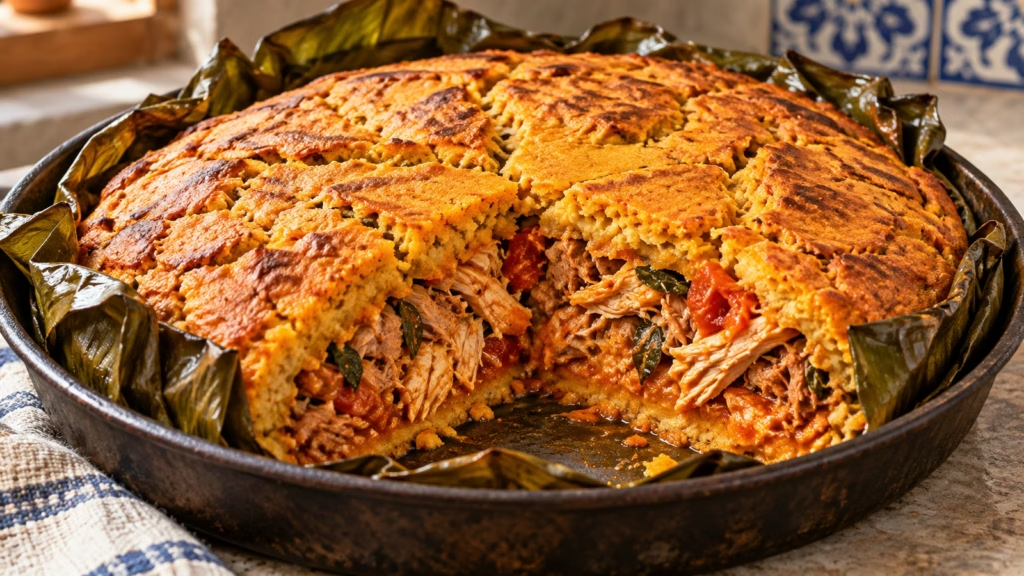
When a spoonful of filling runs across the plate, it is easy to see why mucbipollo needs a thick k’óol. The broth-and-masa mixture holds chicken and pork inside an achiote-colored shell, all wrapped in banana leaves. This home-oven adaptation keeps those defining parts together while giving you clear cues for the filling and crust.
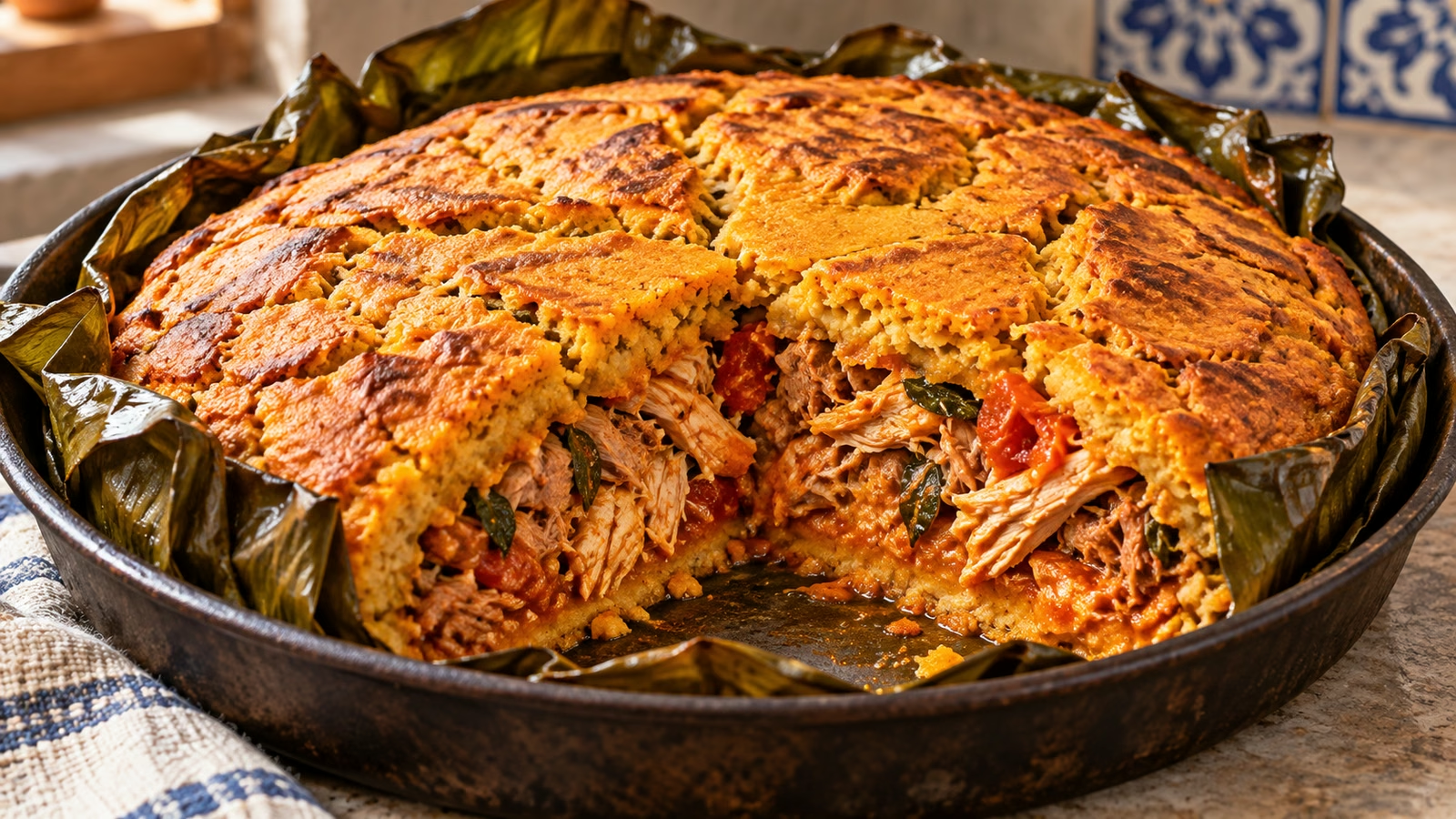
Take care of the filling before closing the masa. A spoon-coating k’óol makes assembly calmer and the finished portions easier to serve.
Mucbipollo, pib and the home-oven adaptation
Mucbipollo, also called pib or mukbilpollo, is a large tamal associated with Yucatán’s Hanal Pixán traditions. The Government of Yucatán describes its corn masa, meat filling, banana-leaf wrapping and traditional underground cooking. A kitchen oven is an adaptation of that method; it does not reproduce an earthen pit.
This recipe makes one deep, round mucbipollo for eight portions. It begins with cooked, shredded chicken and pork, so the oven time mainly cooks the masa and heats the assembled filling. I would arrange the meat and broth in advance, then clear enough counter space for the leaves and dough. A crowded work surface adds difficulty that the recipe does not need.
- K’óol is broth thickened with masa, not simply extra liquid poured over the meat.
- Achiote colors and seasons both the shell and the filling. The salt level varies with the paste you buy.
- Banana leaves enclose the tamal during baking and are removed before eating.
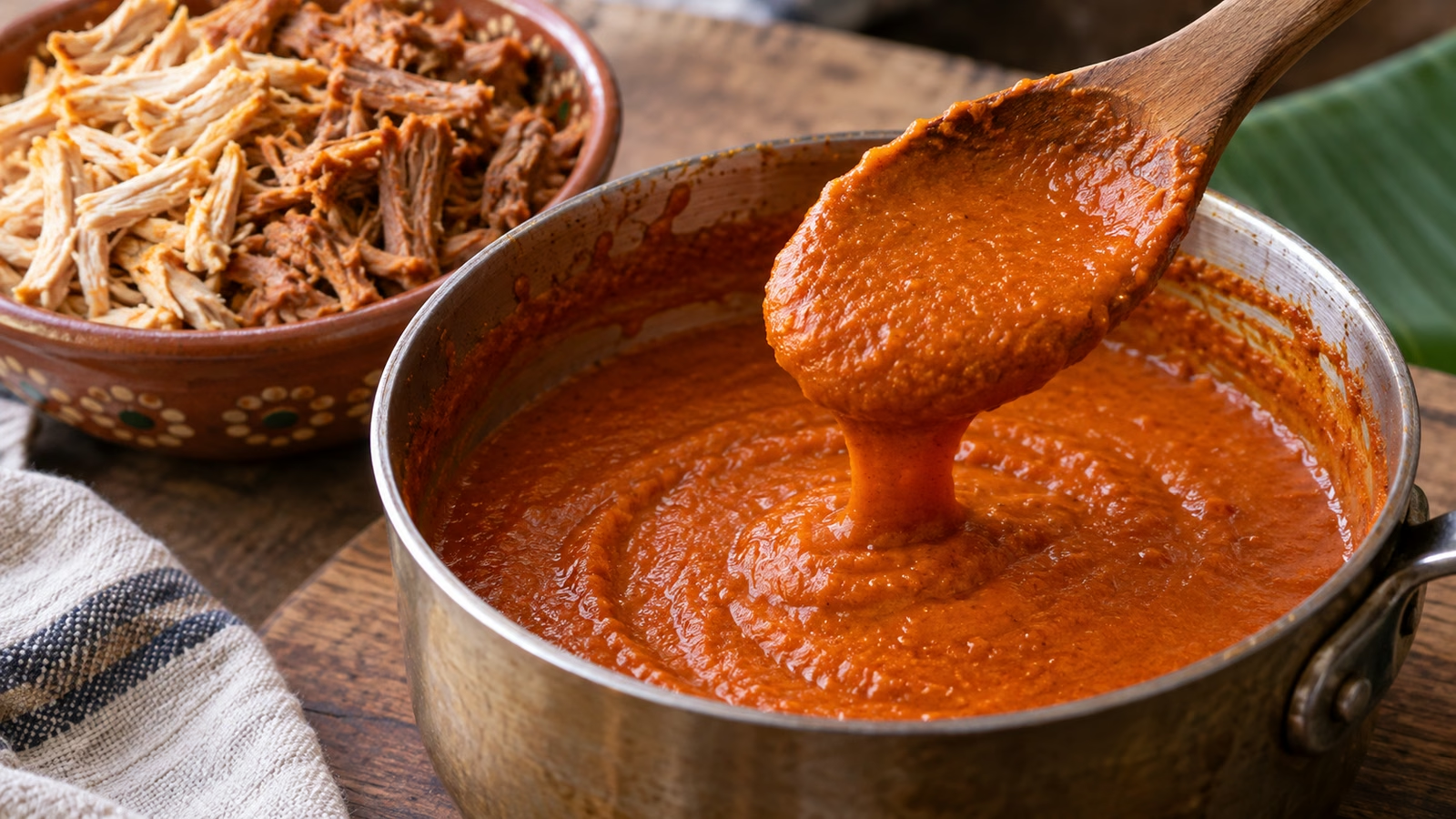
Get the k’óol right before assembly
Whisk the small measured portion of fresh masa and achiote into some of the broth before adding it to the pan. This creates a smooth mixture instead of dropping a lump of dough into hot liquid. Cook it with the softened onion, garlic and tomato until it coats the spoon, then fold in the cooked meat.
- Use ready-to-use broth. If you begin with a concentrate, dilute it first; our chicken bouillon guide explains why the label matters.
- Keep the meat weights tied to cooked, boneless portions: skinless chicken thigh and trimmed pork shoulder.
- Let the filling stop steaming vigorously before placing it in the shell. It should remain moist without resembling a bowl of soup.
- Check seasoning in the cooked filling before assembly, accounting for the broth and achiote rather than automatically adding more salt.
I would give this stage more attention than the color of the finished top. A deep orange sauce can still be too loose. If the k’óol needs a little longer to thicken, keep stirring across the bottom over moderate heat instead of trying to correct it with an unmeasured handful of flour.
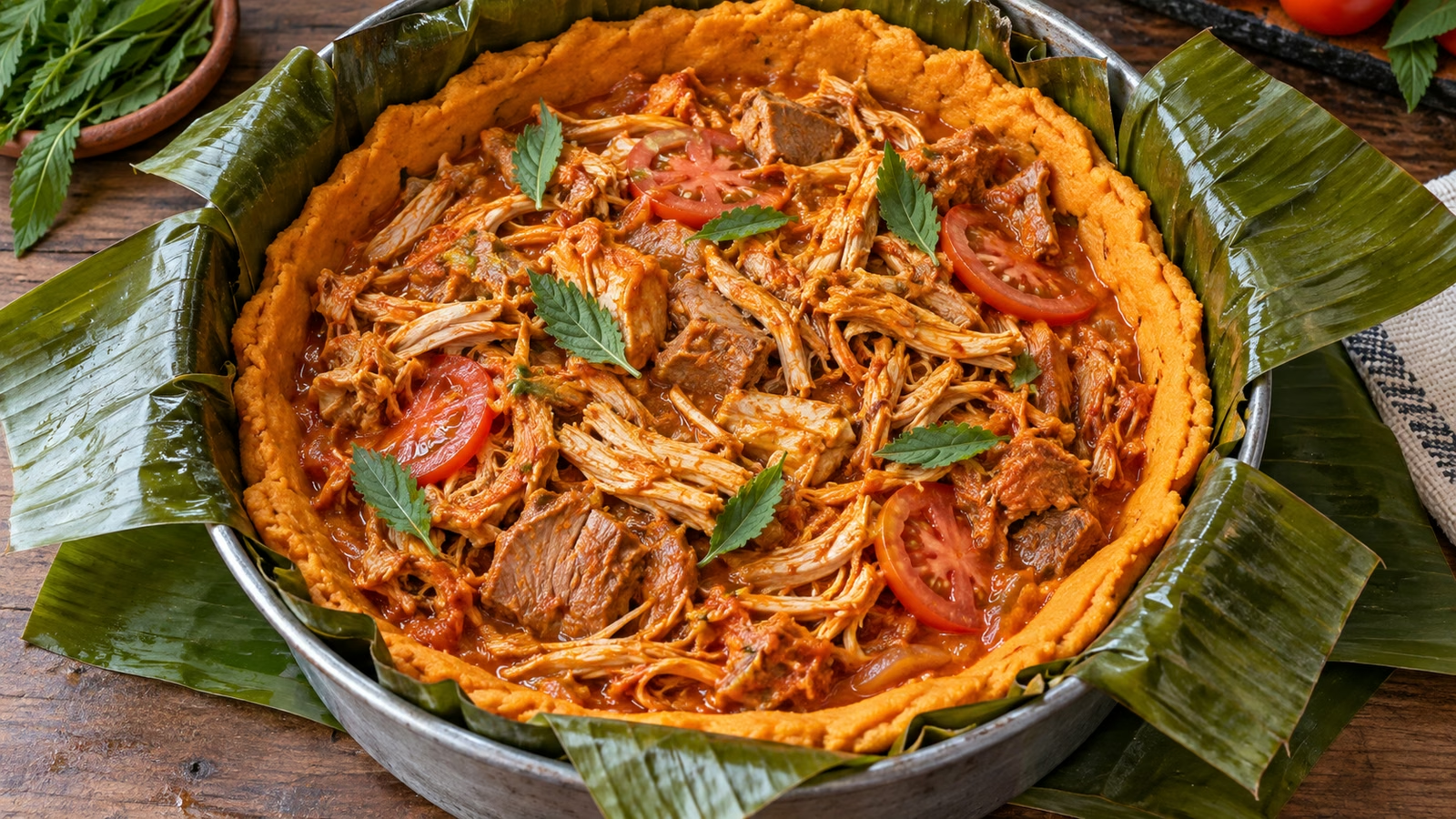
An even shell makes the bake more predictable
Line an approximately eleven-inch-wide, deep baking pan with softened banana leaves, overlapping any splits. Leave enough leaf overhang to close the top. Fresh masa is moist dough; the 2.2 pounds listed for the shell cannot be replaced with 2.2 pounds of dry masa harina.
- Work the masa with the lard, dissolved achiote and salt until pliable. Add extra water only by the tablespoon if the dough cracks.
- Press about two-thirds of the dough over the bottom and sides, keeping the layer close to three-eighths of an inch thick rather than leaving heavy corners.
- Add the meat and thickened k’óol, followed by the sliced tomato and epazote.
- Flatten the remaining dough between food-safe sheets, transfer it over the filling, remove the sheets and join the edges.
- Fold the banana leaves over the top and cover the pan with an oven-safe lid or foil. No plastic goes into the oven.
Bake at 350°F until the masa is set and the filling reaches 165°F, allowing roughly ninety to 120 minutes. Thickness and pan material affect the timing. Uncover near the end if you want more browning, but do not use a dark surface as proof that the center is cooked.
Rest, portion and save what remains
Twenty minutes of resting gives the hot filling and shell a chance to settle. I prefer a broad spatula for lifting wedges because this is a tender masa casing, not a rigid pastry crust. A little habanero-and-lime salsa is a possible accompaniment for those who want heat, offered separately.
- The stated preparation time assumes both meats are already cooked. Plan their cooking separately if starting from raw.
- The calorie estimate covers one of eight portions with the full shell, lard and filling. It excludes optional salsa.
- Refrigerate leftovers in shallow containers within two hours, or one hour above 90°F. Keep them at 40°F or below and use within three to four days.
- Reheat the center to 165°F. A covered dish helps protect the masa while the filling heats through.
Mucbipollo Recipe

Ingredients
- 2.2 lb fresh white nixtamalized masa 1,000 g; plain and unsalted
- 4.6 oz lard 130 g
- 0.7 oz achiote paste 20 g; half of the total paste
- 3 tbsp plus 1 tsp water 50 ml, for the achiote
- 2/3 tsp fine salt 4 g
- 14.1 oz cooked skinless chicken thigh meat 400 g, skinless and boneless, stewed then shredded; cooked weight
- 12.3 oz cooked pork shoulder 350 g braised arm-picnic shoulder, separable lean only, shredded; cooked weight
- 2 1/2 cups ready-to-use chicken broth 600 g
- 2.8 oz fresh white nixtamalized masa 80 g, for thickening
- 0.7 oz achiote paste 20 g
- 0.7 oz lard 20 g
- 12.3 oz tomatoes 350 g: chop 200 g and slice 150 g
- 3.5 oz onion 100 g, chopped
- 2 garlic cloves 6 g, minced
- 0.14 oz fresh epazote leaves 4 g, washed
- 3 large pieces of food-grade banana leaf enough to line the pan and cover the top
Equipment
- Deep 11-inch round baking pan About 2 1/2 inches deep (28 × 6 cm)
- Saucepan
- Oven-safe lid or foil
- Kitchen scale
- Instant-read thermometer
Instructions
- Heat the oven to 350°F (180°C). Wash the banana leaves, trim the hard ribs and soften briefly over a warm griddle or in hot water. Line the pan with overlapping leaves, leaving enough overhang to close the top.
- Whisk 80 g masa and 20 g achiote into about 3/4 cup plus 1 tablespoon of the broth (200 g). Heat 20 g lard in a saucepan. Cook the onion and garlic for 5 minutes, then add the chopped tomato and cook 5 minutes more.
- Add the remaining 400 g broth and the masa mixture. Stir over moderate heat for 8–12 minutes until thick enough to coat a spoon. Fold in the cooked chicken and pork. Remove from the heat and let the filling stop steaming vigorously.
- Dissolve the remaining 20 g achiote in the 50 ml water. Mix with the 1,000 g masa, 130 g lard and 4 g salt until pliable. Add extra water only as needed, a tablespoon at a time, if the dough cracks.
- Press two-thirds of the masa over the lined bottom and sides in an even layer about 3/8 inch (1 cm) thick. Add the filling, sliced tomato and epazote.
- Flatten the remaining masa between food-safe sheets. Peel off one sheet, transfer the lid over the filling, remove the other sheet and seal the edges. Fold the banana leaves over the top. Cover with an oven-safe lid or foil; remove all plastic before baking.
- Bake for 90–120 minutes, checking that the masa is firm and cooked without a raw center and that the filling reaches 165°F (74°C). Cover and cook longer if needed. For more browning, uncover for the final 10–15 minutes.
- Rest for 20 minutes. Cut into eight portions and lift with a broad spatula. Remove the banana leaves before eating.
Nutrition
Notes
Tried this recipe?
Let us know how it turned out!Sources
- Government of Yucatán: Hanal Pixán and mucbipollo; Yucatán Today: pib and k’óol.
- INCMNSZ, USDA SR Legacy and El Yucateco achiote product information inform the estimate.
- USDA FSIS: leftover handling.
Hi, I’m Laura, the voice behind Tastiva. I’ve always believed that eating well should feel enjoyable, comforting, and realistic—not like another complicated rule to follow. I love creating recipes that fit into everyday life, sharing simple nutrition ideas, and finding small ways to make meals feel a little better without losing the pleasure of good food.