

The Yasso box says frozen Greek yogurt, but that does not tell you everything about the bar inside. A plain Chocolate Fudge bar and a Sea Salt Caramel Chocolate Crunch bar have different coatings, ingredients and nutrition panels. Start with the exact flavor and the label’s portion, rather than assuming every Yasso bar has 100 calories.
Compare the bar you want to eat, not the number you remember from a different box.
This is a current U.S. label guide, not a taste test or a ranking of flavors. I would first decide whether I wanted a smooth frozen bar or a coated dessert, then compare the details that matter to me. “Made with Greek yogurt” is useful ingredient information; it is not the whole decision.
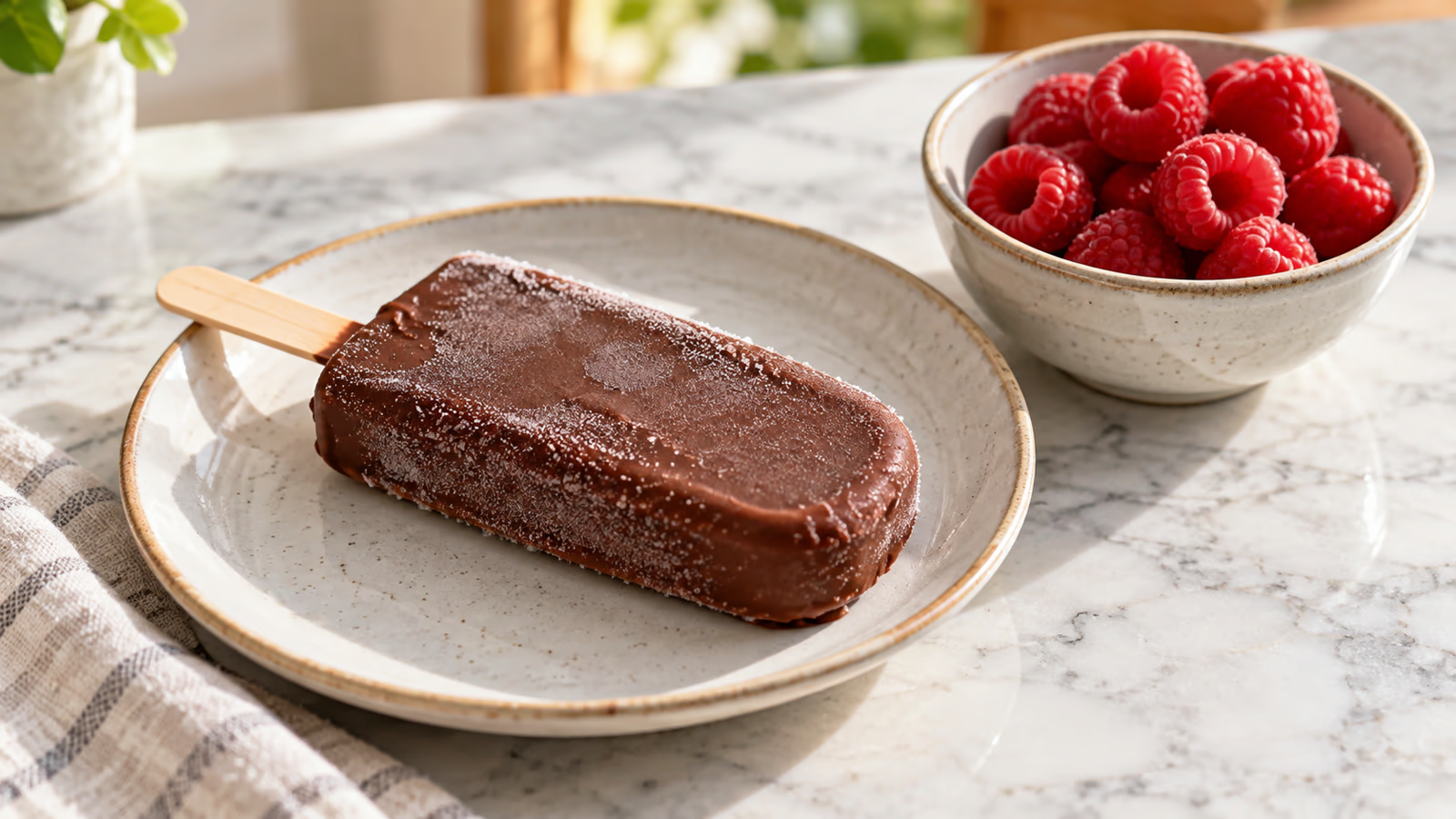
The images here are unbranded serving illustrations, not photographs of Yasso products. Check the actual package for the bar’s appearance, ingredients, and nutrition.
Two Yasso bars, two different labels
The official product pages and their nutrition-panel images, checked October 9, 2026, show the following per-bar values. These are specific products, not averages for the brand. The bars also differ slightly in weight, so this comparison is one bar against one bar, not equal grams.
- Chocolate Fudge: one 65 g bar, 80 calories, 5 g protein, 12 g total sugars, including 8 g added sugars, and 0 g saturated fat on the label.
- Sea Salt Caramel Chocolate Crunch: one approximately 60 g bar, 150 calories, 4 g protein, 15 g total sugars, including 11 g added sugars, and 6 g saturated fat.
The Chocolate Fudge ingredients include nonfat milk, Greek yogurt, sugar and cocoa. The Chocolate Crunch version includes a chocolate-flavored coating, caramel components and crisp quinoa. The coating is part of the dessert’s composition, not just a different flavor name.
Check whether the column means a bar or a serving
Here is the easy-to-miss detail: the Chocolate Crunch panel lists its serving as two bars, 120 grams, while also providing a separate per-bar column. Its 150-calorie figure refers to one bar; the two-bar serving column shows 300 calories and 8 grams of protein. The Chocolate Fudge panel uses one bar as its serving.
- Read the serving line before comparing calories or nutrients. “Per bar” and “per serving” do not always describe the same amount.
- Use the column matching what you actually eat. A listed serving is not a direction to eat that amount.
- When a package has a per-container column, use that printed information rather than assuming rounded per-bar values will multiply perfectly.

The FDA explains how serving information works, and Yasso’s FAQ notes that label rounding can produce small differences in multiplied totals. I would compare both boxes side by side for half a minute; it is simpler than remembering a number from an older flavor or package.
Greek yogurt does not answer every dietary question
Both products contain milk. The Chocolate Crunch label also declares soy, while the Chocolate Fudge page has its own allergen and possible cross-contact information. If you manage an allergy, read the exact package each time rather than transferring another flavor’s declaration to it.
- Lactose: do not assume a dairy frozen-yogurt bar is lactose-free. Look for an explicit claim that meets your needs.
- Milk allergy: lactose-free and dairy-free are different questions. Our lactose-free ice cream guide explains that distinction.
- Gluten: the brand’s FAQ identifies exceptions among its bar flavors, including Chocolate Chip Cookie Dough, Cookies n’ Cream and Fudge Brownie. Check the current flavor label.
- Sugar: no sugar alcohols does not mean no sugar. Total sugars include naturally occurring and added amounts; the added-sugars line helps separate them.
A frozen dessert containing yogurt should not automatically be treated as a probiotic intervention or a substitute for a meal. If you need a product to meet a medical nutrition target, use the complete panel and your clinician’s guidance. The brand name cannot establish suitability for everyone.
Choose the dessert, then keep the box useful
For a straightforward snack, one individually portioned bar can be convenient. If you want a more substantial meal or snack, consider what else you are eating rather than asking the bar to cover every need. Fruit alongside it is a serving option, with its own additional nutrition.
- Compare saturated fat, added sugars and protein as well as calories. One number does not capture the difference between these two products.
- Use the brand’s store finder as a starting point for availability, then check the retailer. A listed store is not a guarantee that your flavor is in stock.
- Keep the product frozen and follow its package instructions. The FDA recommends a freezer temperature of 0°F (-18°C).
- Save the box until the bars are finished if you need its ingredients, allergen details, date or lot information.
I would choose a flavor because I wanted that dessert, with the label helping me understand the portion. These comparisons do not establish that every Yasso product is nutritionally identical, universally healthier than ice cream or appropriate for every diet.
For help evaluating the label and front-of-package claims, the FDA’s expert presentation below explains serving sizes, Daily Values and nutrition claims. It is general education, not an endorsement of Yasso.
Sources
- Yasso: Chocolate Fudge bars and nutrition panel.
- Yasso: Sea Salt Caramel Chocolate Crunch bars and nutrition panel.
- Yasso: allergens, gluten, rounding and availability FAQ.
- FDA: serving sizes and label columns.
- FDA: total and added sugars.
- FDA: freezer temperature and safe storage.

Hi, I’m Laura, the voice behind Tastiva. I’ve always believed that eating well should feel enjoyable, comforting, and realistic—not like another complicated rule to follow. I love creating recipes that fit into everyday life, sharing simple nutrition ideas, and finding small ways to make meals feel a little better without losing the pleasure of good food.